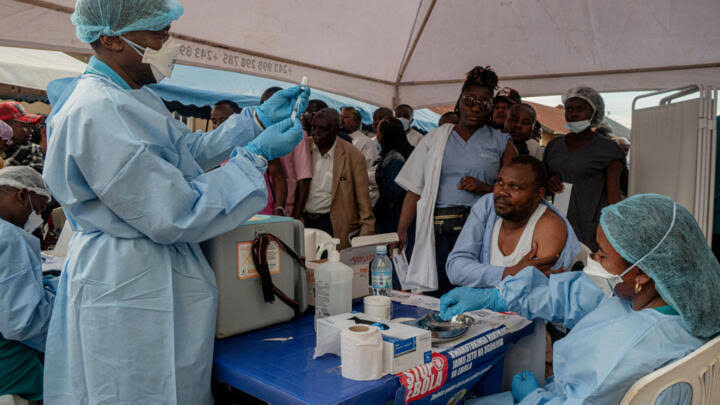
The Ebola outbreak in Congo passed a grim milestone this week- 10,000 confirmed cases- and spurred questions about whether health authorities are losing their ability to contain it.
The Associated Press reports that nearly half of the infected people in this outbreak have died, and some experts say there are reasons to worry that this could grow into the worst Ebola outbreak in history. Others don’t think it will reach that level. Researchers are currently working on updated projections.
Some researchers said current circumstances suggest it’s unlikely to spark significant problems in most other countries. But about 30 confirmed cases have already popped up in other nations. And the risk that more will appear outside Congo will grow if the outbreak isn’t tamed, said Justin Lessler, a University of North Carolina researcher who studies the dynamics of infectious disease outbreaks.
Experts are also hopeful that a vaccine will become available next year that could help control it.
At a virtual summit of African health ministers on Wednesday, Africa CDC Director-General Dr Jean Kaseya said the continent is “not winning” the fight against Ebola and needs to do more after it spreadto multiple African countries. “Together, we agreed to prepare every country, coordinate across our borders and keep these borders open while watching them closely,” Kaseya wrote on social media.
About 400 new cases have been confirmed in Congo each week, and that number seems to be holding steady. It’s good news that “cases are not rising exponentially,” at least for the moment, said Dr Boghuma Titanji, an Emory University infectious disease specialist.
A major challenge in Congo is limited contact tracing and collaboration with affected communities; health workers sometimes spend more time trying to convince residents to work with them than giving care.
Fewer than a quarter of new cases are coming from people who are known to have been in contact with an infected person, showing there are ongoing chains of transmission that health authorities are not aware of.
As cases mount, the likelihood grows that more infected people travel to other countries, Titanji and other experts said. France, Kenya, Nigeria and Uganda also have reported cases tied to the Congo outbreak.
Travel restrictions can make it harder for the virus to leave Africa. In many places where a traveller’s infection may surface, health officials should be able to quickly isolate the infected person and find any contacts, experts say.