Egungun is a Yoruba word that means ancestral spirits or spirits of the dead.
According to the Nigerian Community Online, the word comes from Egun (ancestor) and gun (to rise), meaning the spirits of the dead are honoured and lifted.
Egungun is important because in Yoruba culture, people believe that ancestors are still connected to the living. If honoured properly, they protect, bless, and guide their families. But if forgotten, they may bring misfortune. The Egungun festival is a way to show respect and keep this connection strong.
Families use the Egungun Festival to celebrate their ancestors and ask for their blessings.
Egungun spirits remind people to follow traditions and behave well.
Some Egungun spirits bring healing and protect the community from bad luck.
The festival is a time to enjoy music, dance, and history.
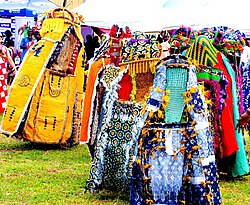
During the festival, masked dancers wear beautiful, colourful costumes made of layers of cloth. People believe these dancers are possessed by the spirits of their ancestors. They move through the town, blessing people, dancing, and sometimes warning those who have done wrong. The Egungun communicate gutturally, through their movements and the sounds of drums.
When Yoruba people were taken to the Americas during the slave trade, they carried the Egungun tradition with them. Today, it still exists in:
Beazil
Cuba
Jamaica
USA
Egungun is not just an old tradition; it’s a powerful way for the Yoruba people to remember their ancestors, celebrate their heritage, and stay connected to their past. It is a mix of spirituality, culture, and history, showing that the dead are never truly gone; they live on through those who honour them.
According to Orisa Blog, the Egungun’s collective functions cut across lineage and family loyalty.
They protect the community against evil spirits, epidemics, famine, witchcraft, and evil-doers, ensuring their well-being.
The spirits could be evoked collectively or individually.
The place of call is either the family shrine or the community grove.
Ancestral spirits may be invited to the earth physically in masquerades, and such masquerades are referred to as Egungun or Ara Orun.
The supernatural powers they have over the community become real as different Egungun perform their religious, political, and social functions.
According to Historical Nigeria, Egungun festival is Nigeria’s astonishing festival where the ancestors are believed to walk among the living.
Behind the whirling masks, thunderous drums, and flowing costumes lies one of Afriva’s most mysterious and enduring spiritual traditions.
The air vibrates with anticipation. Children cling to their parents while elders bow their heads in quiet respect. Suddenly, from a narrow street, a towering figure wrapped in hundreds of layers of brilliantly coloured cloth begins to spin.
The fabric flies through the air like a living whirlwind.
No one dares touch it.
Some spectators step back instinctively. Others stretch out their hands in reverence. Women sing ancestral praise songs while drummers match every movement of the mysterious figure.
To an unfamiliar visitor, it might look like an elaborate masquerade or a spectacular cultural performance.
But to countless Yoruba people, something far more profound is taking place.
This is not simply a masked dancer.
During the festival, many believers regard the Egungun as the spiritual manifestation of departed ancestors returning to bless, advise, protect, and sometimes even discipline the living.
For centuries, this extraordinary tradition has fascinated explorers, missionaries, historians, anthropologists, and travellers alike. It has survived the collapse of kingdoms, the Atlantic slave trade, British colonial rule, religious transformation, urbanization, and globalization.
Yet outside West Africa, surprisingly few people know that one of humanity’s most remarkable traditions continues to thrive in Nigeria today.
It is a celebration where history, spirituality, theatre, music, family, and identity become inseparable.
Once you understand the story behind the masks, you never look at them the same way again.
According to Historical Nigeria, the exact beginnings of the Egungun tradition remain impossible to date with certainty because its earliest history was transmitted orally long before written records existed.
Most historians and Yoruba scholars agree that ancestor veneration formed part of Yoruba religious life centuries before European contact with West Africa. Archaeological evidence confirms that organized Yoruba kingdoms flourished many centuries before the arrival of Portuguese traders in the fifteenth century.
Within this religious worldview, death did not represent the end of existence.
Instead, worthy ancestors continued living in the spiritual realm while maintaining an active relationship with their descendants.
These ancestors could offer guidance, fertility, prosperity, protection, justice, and blessings.
The Egungun institution emerged from this belief.
Rather than merely remembering deceased family members, communities developed elaborate ceremonies through which ancestral spirits were believed to symbolically return among the living.
Although traditions sometimes attribute the origin of Egungun to legendary founders of Yoruba civilization, these stories differ from one community to another and cannot be verified as historical fact. They are best understood as sacred traditions that express cultural memory rather than documented history.
Egungun represents an entire religious and cultural system centred on honouring ancestors.
In Yoruba belief, the ancestors remain active members of the extended family.
Their physical bodies may have died.
Their influence has not.
During festivals, specially initiated members of Egungun societies wear elaborate costumes that completely conceal their identity.
Within traditional belief, the individual inside the costume is no longer viewed merely as himself.
He temporarily embodies ancestral presence for the community.
This distinction explains why spectators traditionally treat Egungun with profound respect.
One of the most fascinating aspects of Yoruba spirituality is the belief that the worlds of the living and the ancestors are closely connected.
Rather than existing in complete separation, both realms continually influence one another.
The Egungun festival symbolizes this meeting point.
It reminds communities that every generation stands upon the sacrifices of those who came before.
The ancestors are remembered not only for their achievements but also for their responsibility toward future generations.
This philosophy strengthens family bonds across time.
In Many ways, the living inherit bith the blessings and responsibilities of their ancestors.