We were so innocently naive in elementary classes that when teachers taught us Mungo Park discovered the River Niger, we just let it sink in without thinking. Of course, he must have met some people (Africans) there.
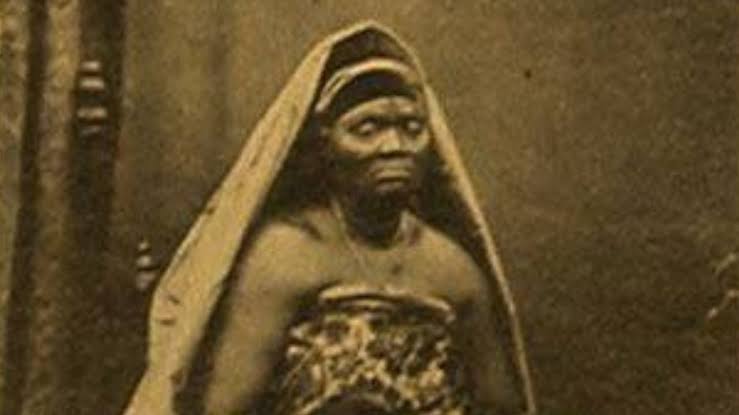
In the same vein, we were taught that Madam Efunroye Tinubu (c. 1805-1887) was the first woman to own a car in Nigeria. Many landmarks, including the famous Tinubu Square in Lagos, Nigeria, were named after her. She was also honoured with the title of Iyalode of Egbaland recognizing her leadership among women and her political importance.
We were not taught that she was a leading slave trader of her era!
Madam Tinubu hailed from Abeokuta in the present Ogun State.
She was first married to a man of Owu ancestry with whom she had two sons. However, when the man died, Madam Tinubu moved to Lagos. While in Lagos, she expanded her trading activities.
She then got married to the King of Lagos, Adele, while he was in exile in Badagry in 1833.
After their marriage, they lived in Badagry, where Tinubu expanded her trading activities using the connections available through Adele.
Around 1835, Adele was restored to his throne and returned as Oba. Naturally, Tinubu returned with him to Lagos.
However, Adele also died about two years later in 1837.
She later got married to Yesufu Bada, an Islamic scholar.
Tinubu was a wealthy woman who built her powerful trading empire in Lagos and Abeokuta. She was a major figure and “kingmaker,” using her wealth and influence to support rulers and shape regional politics.
Although she is celebrated for her entrepreneurial success, philanthropy, and resistance to some colonial policies, at the same time she was a participant in the skave trade, particularly before and, according to many accounts, even after British efforts to abolish it in Lagos.
Now, that brings us to the crux of the matter. In the first instance, I wouldn’t want to excuse anyone involved in the despicable act of selling human beings from any punishment due to them, even in death. By the way, slavery must have included warfare, killing, maiming, rendering children motherless and/or fatherless and even participation in child slavery.
Even though she was already wealthy and influential, she continued the trade after it was abolished in Lagos.
She never cared about being involved in a system that caused profound human suffering.
Now, let’s look at her unlucky victims – victims of the slave trade – I don’t see them remembering her as a successful merchant or political leader. They would, instead, have seen her as a person who participated in a system that involved the capture, sale, transportation, and exploitation of human beings.
The poor, enslaved people and their families would have experienced that system through loss of freedom, separation from loved ones, violence, forced labour, and the denial of their humanity.
While not denying that Tinubu had political, economic, or entrepreneurial achievements, the question is whose suffering may have made those achievements possible.
Wealth from the slave trade was not simply an economic transaction – it represented people turned into commodities.
Second, a political struggle over control of trade routes was, for those being traded, a struggle over whether they would be free or enslaved.
Third, a person’s social status in a slave-based economy could be built partly on the suffering of those without power.
There is a saying that if one’s death doesn’t come from within, it’s hardly possible for outsiders to succeed in killing a person. There is no reason not to believe that if African actors had not been involved, European and American participants wouldn’t have been so successful in the slave trade. While not necessarily denying the central responsibility of European colonial powers and Atlantic commercial systems that expanded and industralized the trade, African histories must also confront their own internal actors.
The question is, can someone who contributed greatly to their society still be considered unworthy of public honour if their success was connected to the suffering of others?
I will say an emphatic yes!
Public commemoration should begin with empathy for those who had no monuments, no political voice, no gravestone, and no ability to record their own stories.
A victim-centred history should therefore not necessarily erase Madam Tinubu from Nigerian history. It would place her in a fuller narrative: a powerful woman of her era, but also one who participated in a system that inflicted suffering on countless powerless people.
Although she had the wealth, influence and political power to stop the slave trade, she continued with it even after it was abolished in Lagos by the British.
Although she was a successful trader of foodstuffs, local commodities, tobacco, salt and other provisions. When she moved to Lagos, her business expanded into palm oil, arms and ammunition trading. However, she was also a conscious participant in the slave trade, which was then a major part of the Atlantic economy and regional commerce.
There were successful individuals of that era who lived worthwhile lives without involving themselves in the slave trade. Bishop Ajayi Crowther, Oba Kosoko, and Olaudah Equiano lived within that period, and there is no evidence that they participated in the slave trade.
Others built influence through: education, agriculture, legitimate trade, missionary work, crafts and professional occupations.
Two individuals, Edward Colston and Robert Milligan, who have been linked to slavery, eventually got rewarded with:
Edward Colston, a Bristol merchant whose philanthropy funded schools and charities, had his statue in Bristol removed in 2020 after long-standing controversy over his role in the transatlantic slave trade. Numerous schools, buildings, and charitable institutions bearing his name were also later renamed.
Robert Milligan was a prominent merchant and slave owner associated with London’s docklands. His statue outside the Museum of London Docklands was officially removed in 2020 because of his links to slavery.
Others, such as Cecil Rhodes, King Leopold II, Hendrik Verwoerd, and PW Botha, who were linked to colonialism or apartheid, also had their honours divested from them, yet they are still remembered.
Should Nigeria continue glorifying people who facilitated the slave trade?