Photo credit: The Guardian
There was a time when the Nigerian politician needed your vote.
Those were the good old days. That was when there was accountability.
You could see the average politician was doing something worthwhile with your vote in his kitty and your tax in his “care”.
The politician was your neighbour. He didn’t run to live in a more comfy part of the city after being elected.
In fact, he came to your house. He attended meetings with you. He shook your hand, called you my people, promised roads, schools, electricity, and jobs.
Even before he asked, you were willing to give him your ballot because he had earned it.
However, Nigerian politics discovered a cheaper currency: the stomach.
The voter became someone who could be persuaded with cash, food, transport money, gifts or promises of patronage. The language of political competition gradually changed from “What will you do for us?” to “What will you give me now?”
The politician is wise in these things. He used hunger and lack of facilities as a weapon so that the people would keep depending on him.
This is what Nigerians have come to call the politics of the stomach, aka stomach infrastructure.
But the events surrounding the 2026 Osun State governorship election raise a more disturbing question: What happens when the politics of the stomach is no longer enough?
What happens when political competition moves from buying consent to creating fear?
That is where we get our nemesis and welcome the politics of the gun.
There is nothing particularly Nigerian about politicians weaponizing poverty. Political patronage exists in democracies around the world. But in a society where poverty is widespread, and the state has failed to provide basic economic security, the poor voter becomes particularly vulnerable.
A politician doesn’t necessarily have to convince such a voter that his policies are superior. He may simply have to make an immediate offer.
A few thousand naira can become more tangible than a manifesto.
A bag of rice can become more convincing than a development plan.
An urgent 2k ir transport money can become more valuable than a promise of better public transportation.
And so the ballot begins to depreciate.
The tragedy is not that poor Nigerians accept such inducements. The deeper tragedy is that political elites have learned to turn poverty into an electoral instrument.
The citizen who should be asking, “What have you done with public money?” is instead encouraged to ask, “What can you give me today?”
Politics becomes transactional.
The voter is no longer treated primarily as a citizen.
He becomes a customer.
There is, however, a limit to what money can buy.
A politician can buy someone’s temporary support. He cannot always buy genuine loyalty.
He can distribute money at a polling station. He cannot be certain what happens inside the polling booth.
He can feed a crowd. He cannot completely control its political preferences.
This is where the politics of the stomach can evolve into something more sinister.
If inducement cannot guarantee the desired outcome, intimidation becomes tempting.
And intimidation does not need to persuade.
It simply needs to frighten.
The politics of the gun represents a fundamental departure from democratic politics.
The politics of the stomach says:
“Vote for me because I can give you something.”
The politics of the gun says:
“Do not oppose me because there may be consequences.”
One seeks to purchase consent while the other corrupts choice.
The other attacks the very possibility of choice.
Democracy is not merely the presence of ballot boxes, but it requires that citizens be able to exercise their political choices freely, without fear.
Osun’s uncomfortable warning:
This is why the violence surrounding the 2026 Osun election deserves to be examined beyond the immediate political accusations between the parties.
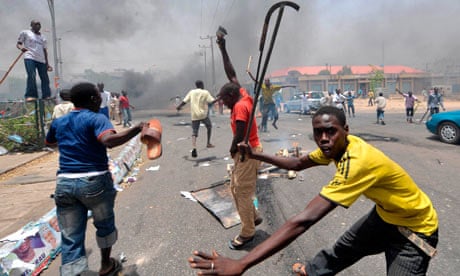
A source reported 73 election-related violent incidents and 29 deaths during the period leading up to the election. Other reports put the number of people killed in the pre-election violence at around 30.
There were also reports of armed men attacking an INEC voter-card distribution centre in Okuku.
When people are killed, attacked, threatened or intimidated because of political competition, the question is no longer simply who will win the election?
The question becomes:
What kind of political system requires citizens to risk their lives to exercise their constitutional right to vote?
There is something almost literary about the Nigerian political experience.
Chinua Achebe’s A Man of the People remains remarkably relevant because it portrays politics as a world of patronage, money, manipulation and political opportunism.
The politician does not necessarily win because his ideas are superior.
He wins because he understands how power works.
Achebe’s fictional world, therefore, offers an uncomfortable mirror of Nigerian political life.
The politics of the stomach represents the moment when political power discovers that poverty can be converted into votes.
The politics of the gun represents the moment when political power discovers that fear can be converted into silence.
The combination is potentially devastating.
The central lesson of Osun should therefore not be limited to which party won or lost.
Nigeria needs to ask a more uncomfortable question.
Are our elections still primarily contests for citizens’ consent, or are they becoming contests for the control of citizens?
A functioning democracy does not need citizens to love politicians. It does not even require voters to trust them completely. It requires much less: The freedom to say yes, the freedom to say no, and the freedom to change one’s mind.
When Nigeria’s politics stops asking for your vote and starts buying your stomach or frightening you with a gun, the problem is no longer merely who wins an election.
The problem is whether democracy itself is winning.