Photo credit: NDTV
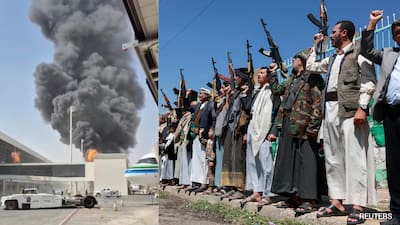
At least 12 people were killed and over 300 injured following a strike on Riyadh’s international airport on Saturday – the third attack this week – as Yemen’s Houthi forces stepped up their campaign against the kingdom.
The Independent reports that the Saudi civilian aviation authority confirmed the casualties, saying four Saudis, two Bangladeshis and one person each from the US, Jordan, Palestine, Syria, Sudan, and Egypt were killed.
At the latest count, officials said 309 people were injured.
Hospitals were overwhelmed with casualties brought in by ambulance and helicopter, according to people briefed on the situation. Some of the injured people were reported to be in critical condition.
The attack, the deadliest in the kingdom in almost a decade, struck without warning, as no alert was issued by Saudi Arabia’s threat warning system. Two earlier attacks this week targeting King Khalid International Airport left four people dead and severely damaged a Saudi commercial aircraft parked on the tarmac.
The fatal strikes highlight vulnerabilities in the country’s defence capabilities while it conducts an air campaign against the Houthis in Yemen. A Saudi-led military coalition promised to retaliate.
The Saudi civil aviation authority said operations at the Riyadh airport were temporarily suspended on Saturday and all flights were diverted. The aurport serves as a city of about eight million.
Following the strike, the head of the Houthi media office posted on social media that the movement had “shut down Riyadh international airport”.
The Houthis warned commercial airlines to avoid Saudi airspace, declaring it a military operations zone after Saudi-backed Yemeni forces launched an offensive on Monday.
In the US, President Donald Trump was asked by reporters if Washington intended to join the Saudi m ilitacampaign in Yemen.
“We may. We’re going to look at it. We just found out about the recent attack, so we’ll make a decision. We move very quickly,” he said.
Saudi Arabia entered the Yemen war in 2015, leading an Arab coalition to attempt to drive the Houthis from the capital Sanaa after the rebels had seized the city the previous year.
The war resulted in a devastating stalemate, with hundreds of thousands of Yemenis killed by fighting and starvation.
Saudi Arabia subsequently signed a 2022 agreement with the Houthis, vfreezing the conflict.
That ceasefire unravelled over the summer, culminating in a rapid Houthi advance that seized the Red Sea chokepoint of Bab el Mandeb from Saudi-backed forces. The Saudi-supported forces launched a new offensive this week to reclaim that territory, making slow progress even as Houthi forces pla ced Taiz, the country’s third-largest city, under siege.