Photo credit: Aljazeera
Bishop Raphael Bahebwa is in hiding, fearing he could be attacked for speaking out for foreigners’ rights in South Africa.
“I am in hiding now because they say they are going to kill me for speaking about the rights of foreigners,” he told Al Jazeera.
Bahebwa has lived in South Africa for 26 years, after arriving as a refugee from the Democratic Republic of Congo (DRC).
He has watched anti-foreigner sentiment flare repeatedly in the country he came to call home. But he says this year feels different.
A September 30 deadline declared by March and March, an anti-immigrant movement that has led to protests across South Africa this year, has renewed fears of violence among migrant communities.
The group has called for undocumented foreign nationals to leave South Africa and has warned of further demonstrations if its demands are not met.
For Bahebwa and other refugees in Durban, however, the distinction between documented and undocumented migrants offers little comfort. They say the hostility they experience on the streets rarely begins with a request to see their papers.
South Africa will hold local government elections on November 4, in a campaign in which migration has become an increasingly prominent political and social issue.
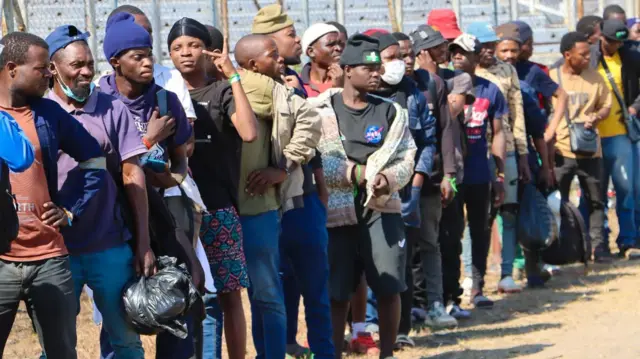
For months, Bahebwa was among hundreds of refugees and asylum seekers who slept on the pavement outside the Durban Refugee Reception Centre on Che Guevara Road.
Many were from DRC and Burundi, with others from Uganda, Mozambique and Tanzania. They said they had fled their communities because they feared anti-foreigner attacks.
They arrived outside the Department of Home Affairs (DHA) office seeking safety.
Instead, the pavement became their home.
For roughly four months, men, women and children slept outside, exposed to the elements and dependent on civil society organizations and volunteers for food and other necessities.
Some of the migrants told Al Jazeera that conditions became desperate. They described irregular access to food and medication and said one man who had tuberculosis died while living at the camp. Al Jazeera has not independently established the circumstances of his death.
The camp was also not far removed from the hostility its residents said they had fled.
On September 3, members of March and March confronted refugees and asylum seekers living outside the centre. Violence broke out, and police intervened. At least four people were reported injured.
At another protest days later, police officers stood between the two groups, forming a barrier as tensions rose.
March and March has described its mobilization as a campaign against undocumented immigration, crime and deteriorating conditions in South African communities.
The group says the government’s response to immigration enforcement has been insufficient.
Its leaders have repeatedly rejected accusations that their campaign is xenophobic and insist their target is undocumented migration rather than foreign nationals generally.