Photo credit: Toronto Star
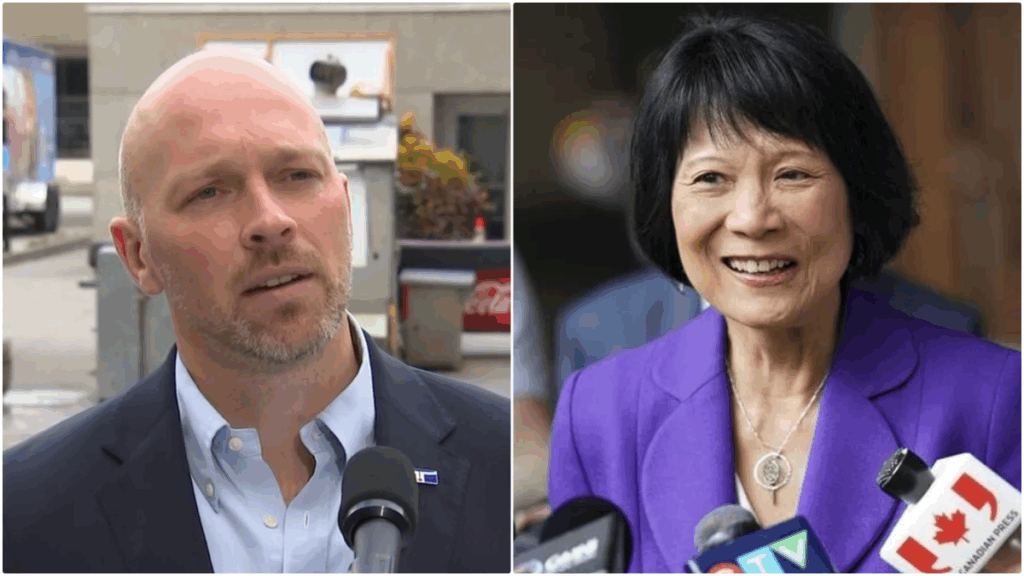
As the two leading candidates to be mayor fanned out for the last weekend of campaigning, they described contrasting perspectives of Toronto: one where a new dawn is breaking and one where a city is broken.
Toronto Star reports that, with the rising sun painting the eastern skyline in golden light, incumbent Mayor Olivia Chow stood in the Port Lands and spoke of a city that cares for its neighbours, where residents of homeless encampments now live in transitional housing, thousands of units of affordable housing are being built, and fare-capped transit will soon ease traffic.
Across the town at Humber Bay Shores in Etobicoke, the waterfront skyscrapers were cast in a different light by leading challenger Brad Bradford, who commiserated with people who feel the city has become less affordable and less functional.
Six months ago, Chow held a commanding 18-point lead over Bradford, a two-term city councillor whom she soundly defeated during the mayoral by-election in 2023. Since then, Bradford has closed the gap and, according to multiple polls, sits in a statistical tie with Chow in the final stretch before election day on Monday.
But huge numbers of voters could blunt the impact of that late momentum. More than 222,000 people voted between Oct. 6 and 11 – a record number for the city, and an increase of more than 70 per cent over the number of early voters in the last municipal election.
Inflation has put electorates in a bad mood, and incumbents have been paying the price across Canada.
In an interview with the Star, Chow acknowledged the growing difficulties in Toronto, but cautioned against quick fixes. She said her solution may take time, but it will provide lasting results.
On homelessness, one strategy is to clear encampments with riot police, as was done under previous mayor John Tory, but the tents popped back up shortly afterwards. By contrast, Chow’s approach employed hundreds of outreach workers who spent time with the people in the tents, getting them into transitional housing and treatment programs. It took longer than a police operation, but now 98 per cent of parks are tent-free.
On transit, previous mayors promised new lines but never delivered, she said, pointing to Tory’s vaunted SmartTrack, which has run over budget, been pared back and still isn’t open. Chow’s approach has been to freeze fares and introduce a cap that means no one will pay for more than 47 fares per month. If re-elected, she has proposed bringing in a 10-fare-per-week maximum.
On housing, Chow boasted of her administration’s ability to build modular housing in months, rather than years, and to provide funding to community organizations to purchase existing buildings that are transformed into affordable housing much more quickly than building new.
At a rally on Sunday morning, Bradford said Chow’s solutions haven’t worked and that the city isn’t living up to its potential, describing Toronto as “a city that relies on 4.1 million visits to the food bank every year.”
“A city that has the worst gridlock in North America, where residents lose 100 hours a year in traffic jams. A city where folks turn their deadbolts at the end of the night, and they lie up waiting, concerned that somebody might break in … A city where parents feel like they’re competing in the Hunger Games to register their kids for swimming lessons.”
“We’re not trying to put a man on the moon; we’re just trying to make this city a little bit safer, a little easier to get around, and a little more affordable.”
Bradford has proposed hiring 1,000 new police officers and supports ripping out bike lanes on Bloor. He wants to freeze taxes while keeping a 1.5 per cent annual increase for a building fund. He plans to spin off Toronto Water into a publicly owned but independent utility that can borrow to build rather than use tax dollars to pay for new infrastructure, which he says will save the average homeowner $300 on their water bill annually. He also plans to cut the municipal land transfer tax, which will cost the city some $300 million per year, and pay for it by finding efficiencies in a line-by-line audit of the city budget.