Photo credit: Reuters
Displacement dynamics in Iraq are undergoing a structural shift, as war-driven migration steadily recedes while environmental stress, especially escalating water scarcity, is becoming a long-term driver of population movement. Despite official claims of declining irregular migration and ongoing returns from displacement camps and abroad, climate pressures and upstream water politics are reshaping internal mobility patterns across the country.
Shafaq News reports that over the past years, Iraq’s displacement landscape was dominated by war and its aftermath, particularly the rise and territorial defeat of ISIS between 2014 and 2017. Large-scale internal displacement, cross-border asylum flows, and irregular migration routes defined the movement of Iraqis seeking safety and economic stability.
By the time ISOS was defeated in 2017, the UNDP estimated the scale of destruction at around $80 billion, with nearly 11 million people dependent on humanitarian assistance and more than six million forced into displacement. While over one million Iraqis remain internally displaced today, that legacy is gradually receding.
The Ministry of Migration and Displacement says Iraq is experiencing a “clear transformation” in migration patterns, marked by declining irregular departures and sustained returns of internally displaced persons, alongside voluntary repatriation from Europe and neighbouring countries, particularly Turkiye.
That pattern is also immediate in the government’s efforts to close one of the conflict’s last unresolved chapters. More than 15,000 individuals have returned through rehabilitation and reintegratioon programs, including Iraqis and their families repatriated from al-Hol camp in Syria via the al-Jadaa rehabilitation centre in Nineveh in coordination with the Iraqi government and the US-led Coalition. However, sensitive files, such as Jurf al-Sakhar in Babil, remain subject to ongoing security vetting.
Karrem Al-Nouri, Deputy Minister of Migration and Displacement, said Iraq’s irregular migration wave through routes “such as Belarus, Turkiye, and Libya has decreased by more than half compared to previous years,” particularly among migrants originating from the Kurdistan Region toward Europe.
He attributed this to tighter regional cooperation, EU engagement, and the disruption of smuggling networks, noting that reintegration programs and legal constraints in destination countries, including around 30,000 rejected asylum applications for Iraqis in Germany, have reduced incentives for new departures.
The decline in irregular migration is also linked to the collapse of key transit routes that previously functioned as “pressure valves” for Iraqi youth seeking entry into Europe. The Belarus route, which peaked in 2020-2021, has effectively been shut down, while enforcement along Turkiye’s western corridors and Libya’s Mediterranean departure points has further restricted smuggling networks.
Yet while conflict-related migration is gradually subsiding, Iraqi officials acknowledge that another driver has already begun to emerge.
Al-Nouri confirmed that Iraq has already experienced climate-related displacement in southern provinces affected by drought and desertification, including Dhi Qar, Maysan, Basra, Al-Muthanna, and Al-Diwaniyah. A 2025 estimate by the International Organisation for Migration (IOM) recorded around 168,000 cases of displacement linked directly to environmental degradation.
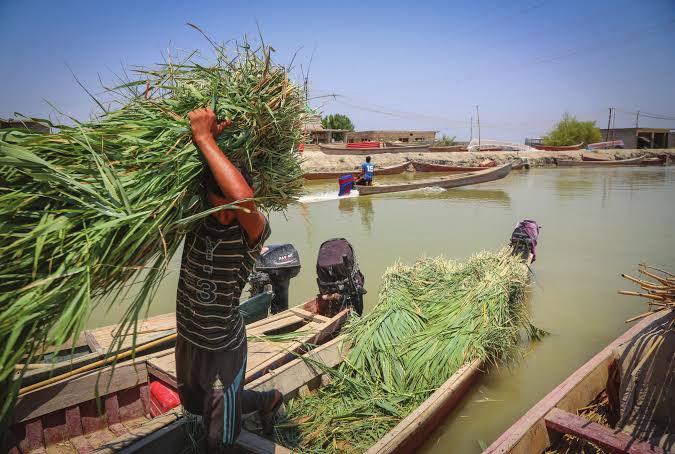
Jassim Al-Asadi, head of the Iraq Nature Group in Chibayish, described the country’s water situation as “complex and dual,” with sharp regional disparities. While some areas have seen temporary improvements in water availability, others along the Tigris continue to suffer acute shortages.
Environmental degradation continues across the central marshes despite temporary improvements in water availability. Communities are gradually moving toward permanent water sources and nearby cities, particularly from rural areas in Dhi Qar.
If current water conditions persist, Iraq may face a new wave of climate-driven mobility, less dramatic than wartime displacement, but more widespread and difficult to reverse.
The easing of conflict-related displacement marks an important milestone in Iraq’s recovery, but it does not signal the end of migration pressures.
Instead, they are becoming slower, more structural, and increasingly tied to water security rather than addressing conflict.
If current shifts continue, Iraq may face a new phase of climate-driven mobility – less dramatic than the mass displacement driven by ISIS, but potentially broader, longer-lasting, and far more difficult to reverse.