Photo credit: Australia Today
It’s no news that young Australians are less religious than their parents and grandparents. Census data has shown a steady decline in religious affiliation for decades, particularly among Christians, who remain Australia’s largest faith group.
SBS News reports that over the past years, there have been reports that seemed to point in the opposite direction. Religious revival in countries as diverse as Japan, Thailand, China, India, Turkey, the United Kingdom and the United States, a common theme emerged. Some young people appeared to be going back to religion.
More supporting still, in many places, the trend seemed driven by young men rather than young women.
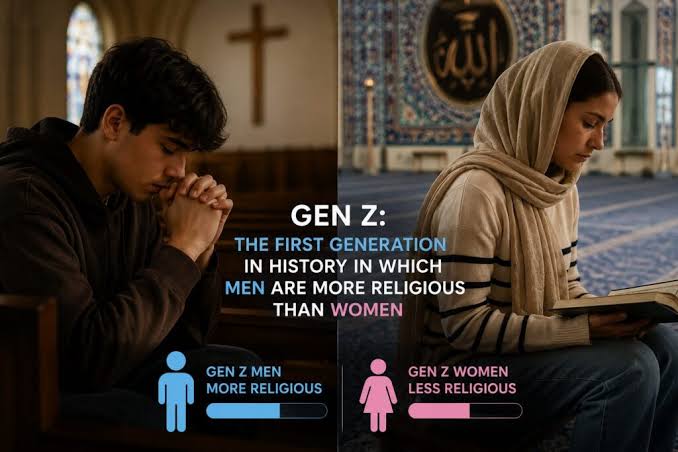
While Australia is continuing to secularize overall, beneath that trend, Gen Z appears to be the first generation where men are more likely than women to identify with religion.
The divode is closely tied to political ideology and may reflect wider gendered political secularism.
Using Australian Election Study (AES) data collection between 1987 and 20025, the author examined religious affiliation across six generations:
X the war generation (born during the 1920s)
X builders (born 1930 – 1945)
X baby boomers (1946 – 1960)
X Generation X (1961 – 1979)
X millennials or Gen Y (1980 – 1994)
X and Generation Z (born after 1994)
Across these cohorts, responses from 27,478 Australians were analyzed. In the analysis, religious affiliation is the primary focus, whether respondents identify with a religion at all.
While church attendance tells us about participation in organized religion, affiliation captures something broader about identity, belonging and self-understanding.
The overall pattern was exactly as expected: religious affiliation declines sharply across generations. Older Australians are significantly more likely than younger Australians to identify with a religion.
The gender pattern showed for every generation from the war generation through to millennials, women are more likely than men to report a religious affiliation.
The researcher then zoomed in on the two youngest generations to see how the gender gap in religious affiliation has evolved.
Millennials (Gen Y) largely follow the familiar pattern seen in older generations. Both men and women become less religious over time, but women constantly remain ahead. In the 2025 Australian Election Study, 46.2% of Gen Y women reported a religious affiliation compared with 40.3% of Gen Y men.
But Gen Z tells a different story.
In the 2025 survey, 55.7% of Gen Z men reported a religious affiliation, compared with 43.2% of Gen Z women.
The pattern survives after accounting for other influences. It’s also still present when political ideology, parental birthplace, marital status and place of residence are controlled for.https://youtu.be/