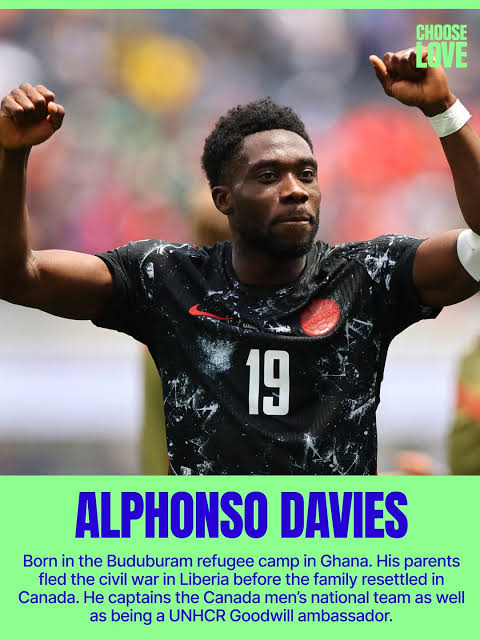
Eight years ago, a 17-year-old boy stood in front of over 200 FIFA officials and delivered a speech. “My name is Alphonso Davies,” he said. “My parents are from Liberia and fled the civil war. It was a hard life, but when I was five years old, a country called Canada welcomed us in. My dream is to someday compete in the World Cup.” And sure enough, he turned that dream into reality. The officials listened. The world watched. And in a room filled with blazers and diplomacy, a teenager from a refugee camp made history.
Times Now reports that Davies is not just competing in the World Cup; he is the captain of one of the host nations, that is, Canada. However, what makes this story special is not where he ended up. It is where he started from. He was born in the Buduburam refugee camp in Ghana. His family had fled there after having survived Liberia’s second civil war. There wasn’t much to life at that point, except surviving. Davies arrived in Canada as a five-year-old with essentially nothing. And he is not the only one.
Across the 48 teams playing at this World Cup, a few players carry their versions of what seems to be the same story. Before the tournament, the United Nations High Commissioner for Refugees (UNHCR) brought them together under a campaign called The Gamechanging Team. A symbolic lineup of 11 professional football players was brought together under this campaign. All these players have backgrounds that have been shaped by war, conflict, inevitable displacement, and the like.
This campaign has arrived when over 117 million people are presently displaced worldwide, and approximately 48.8 million of them are children. As the World Cup takes place in a country that has recently tightened its borders and restricted entry for multiple people, it seems like the UNHCR is making a deliberate point. The point is an emphasis on the fact that these players were never a burden. They are what happens when displaced people are given safety and a chance.
Antonio Rudiger, Germany’s Real Madrid player, was born and raised in a refugee neighbourhood in Berlin after his parents fled Sierra Leone because of the Civil War in 1991. Nestroy Irankuda is a player for Watford FC, who was born in a refugee camp in Tanzania after his parents escaped the Burundian civil war. He is now the youngest Australian player to score at this World Cup.
Mohamed Toure was born in a refugee camp in Guinea. His family had fled Liberia owing to an attack on their hometown. He now represents the Australian football team.
The campaign by UNHCR is about how these stories are told. The campaign is inspired by an artwork by Carling Jackson. It is based on his painting that depicts each of the 11 players as what they are today, and what they once were. The backdrop of the painting showcases the gruesome reality of war and destruction against a bright stadium pitch, which seems to be a subtle way of saying that the child in the camp and the player on the pitch are not two different people.
Having a good life now does not erase the years of hardship that these players were put through. And for every one of them that made it out, millions of children with the same potential remain in camps. Not because they want to, but because they do not have access to the resources that would allow them to go anywhere.
It would do the world some good to ask how many children born in refugee camps ever get the chance to find out what they could have become.