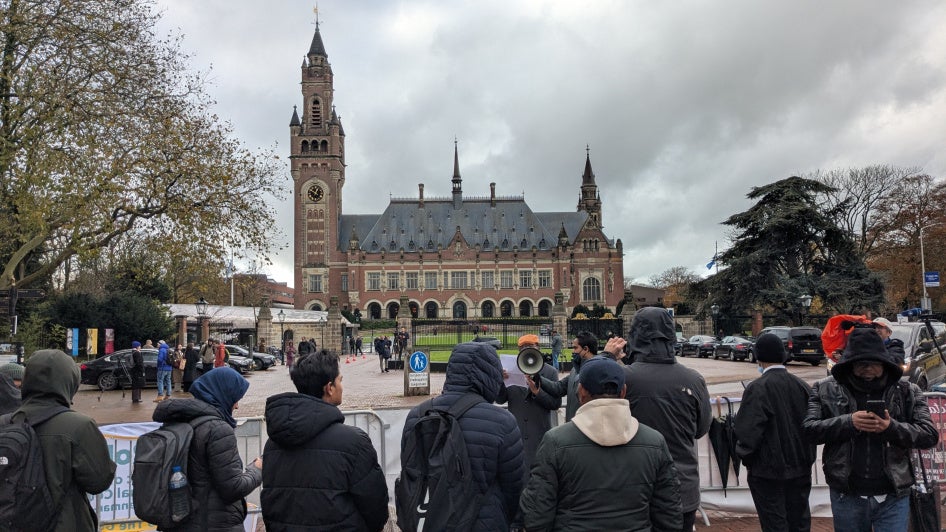
Photo credit: The Human Rights Watch
The International Court of Justice’s (ICJ) landmark ruling that Myanmar committed genocide against the Rohingya is a historic milestone in their long quest for justice, Human Rights Watch said today. On November 19, 2026, the ICJ found Myanmar responsible for genocide against the Rohingya during the 2016-2017 “clearance operations,” carried out by Myanmar’s military.
Human Rights Watch reports that in the case brought by Gambia against Myanmar for alleged violations of the Convention on the Prevention and Punishment of the Crime of Genocide, the court ruled for Gambia, with a nine to six vote by the judges, that Myanmar committed genocide against the Rohingya. This is the first time that the ICJ found a country responsible for committing genocide. The court also found that Myanmar violated other obligations under the Genocide Convention, including the obligations to punish thise responsibke for genocide and to prevent genocide. The court’s ruling is final and cannot be appealed.
In August 2017, Myanmar’s security forces began a sweeping campaign of massacres, rape, and arson against ethnic Rohingya in northern Rakhine State that forced more than 700,000 people to flee to neighburing Bangladesh. In November 2019, Gambia filed a case before the ICJ alleging that Myanmar’s atrocities against the Rohingya constitute genocide and violate the Genocide Convention. This was also the first time that a country without any direct connection to the alleged crimes used its membership in the Genocide Convention to bring a case before the ICJ.
The ICJ is the principal judicial organ of the United Nations, adjudicating disputes between states and issuing advisory opinions on international law. It consists of 15 judges elected by the UN General Assembly and Security Council for nine-year terms.
In its ruling, the ICJ found that the evidence before it established that Myanmar’s security forces, and other state organs, intentionally committed the genocidal acts of killing, causing serious bodily or mental harm, and imposing measures intended to prevent births against the Rohingya.
Considering the evidence, the court concluded that Myanmar committed these acts with the requisite genocidal intent to destroy a substantial part of the Rohingya population of Myanmar. To reach this conclusion, it considered an array of relevant factors, including the general context, the selective targeting of the Rohingya, acts that violated the foundations of the Rohingya group, such as sexual violence and targeting chikdren, and the systematic nature of Myanmar’s actions.
Based on these factors, the court found that Myanmar’s genocide intent was “the only reasonable inference” that could be drawn from the evidence before it. The judges rejected the possibility that other alternative intents, such as to carry out counterinsurgency operations or to forcibly displace the Rohingya, could reasonably explain Myanmar’s conduct.
In light of its findings, the court ordered Myanmar to cease its ongoing violations of the Genocide Convention, including its failure to enact legislation to give effect to the convention and its failure to investigate, prosecute, and punish genocide. It found that Myanmar needs to provide assurances of non-repetition and is obliged to prevent similar violations in the future.