Photo credit: Aljazeera
US President Donald Trump signed an executive order on Monday to impose new 50 per cent tariffs on certain Canadian goods set to begin August 19, including goods previously exempted under the Canada-United-States-Mexico Agreement (CUSMA).
The National Post reports that the tariff is in response to what the US administration views as discriminatory trade practices by Canada, including Canadian tariffs on American autos, US alcohol bans in some provinces and dairy import limits.
Trump used Section 338 of the Tariff Act of 1930, which allows a president to impose duties up to 50 per cent on a foreign country that discriminates against US commerce.
The Canadian products subject to the new tariff include paper products, cement, wood products, dairy, honey, essential oils, hockey equipment and several alcoholic beverages.
According to the White House release, the Section 338 tariff will “not apply to energy, potash, products subject to tariff under Section 232, and certain other goods, such as fish or critical minerals.” Section 232 tariffs currently apply to Canadian steel, aluminium, and copper as well as pharmaceutical products.
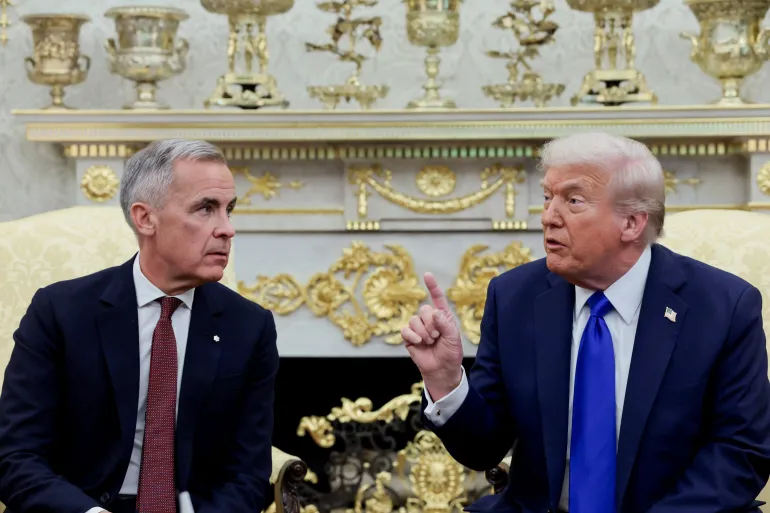
Reacting to the news on Monday, Prime Minister Mark Carney said this 50 per cent tariff is “the latest in a series of unilateral US trade actions that began with US imposing a series of tariffs in direct violation” of CUSMA. Those included tariffs on the Canadian auto sector, and he said: “Canada, as is its right, has merely matched those measures.”
Carney said Canada has made a series of detailed and comprehensive proposals to modernize CUSMA and that his team stands ready to “intensify those discussions in the coming weeks.”
“The trade dispute has raised costs for families, particularly in the US, he continued. “Canada stands ready to engage intensively to address outstanding issues with the US to the mutual benefit of our citizens.”
“In all circumstances, Canada will work relentlessly and take any measures necessary to build our strength at home and to support Canadian workers, farmers, businesses, and families.”
Candace Laing, president and CEO of the Canadian Chamber of Commerce, said her organization shared had shared concerns with the federal government with regard to “the rising threat Section 338 tariffs pose.”
Trump’s trade action comes just a few days after he threatened new tariffs on Canada after smoke from Canadian wildfires blanketed US skies.
Carney was in New Jersey on Sunday for the FIFA World Cup final game, where he met with Trump and Mexican President Claudia Sheinbaum. All three of them congratulated each other on a successful event, according to a statement from the Prime Minister’s Office.
Members of the US administration, including US Secretary of Commerce Howard Lutnick and US Trade Representative Jamieson Greer, have expressed their opposition to the boycott of US alcoholic products by provincial liquor commissions in every province except Saskatchewan and Alberta.
On Monday, Greer said: “While the Administration continues to secure fair and reciprocal trade deals with our trading partners, Canada, unlike other partners and allies, continues to retaliate against the United States for its efforts to rebalance trade and protect US industry in national-security sensitive sectors. Specifically, Canada has taken US alcohol products off Canadian shelves, given better market access to dairy products from the European Union, and has put a cap on US vehicle exports to Canada from companies reshoring to the United States.
The federal government has said that any decision to reverse the alcohol bans remains with the provinces.
Between March 2025 and February 2026, Canadian imports of US alcohol have decreased by 81 per cent, or the equivalent of US$582 million, compared to the year before, according to the White House fact sheet. The US administration takes issue with the drop in US auto imports to Canada, which have decreased by 22 per cent from April 2025 to March 2026.
Wendy Wagner, head of international trade and customs regulatory group at legal firm Growing WLG, said it is “pretty clear” that the Trump administration was looking for different means with which to pressure its trading partner after the Supreme Court in February struck down the tariffs imposed under the International Emergency Economic Powers (IEEPA).
She said this new 50 per cent tariff is “clearly a pressure tactic” to squeeze more concessions out of Canada.
She concluded that while an “emotional response” such as retaliation against the US sounds attractive, it could be really damaging to the Canadian economy. “I think that’s the calculation that has to be made.”