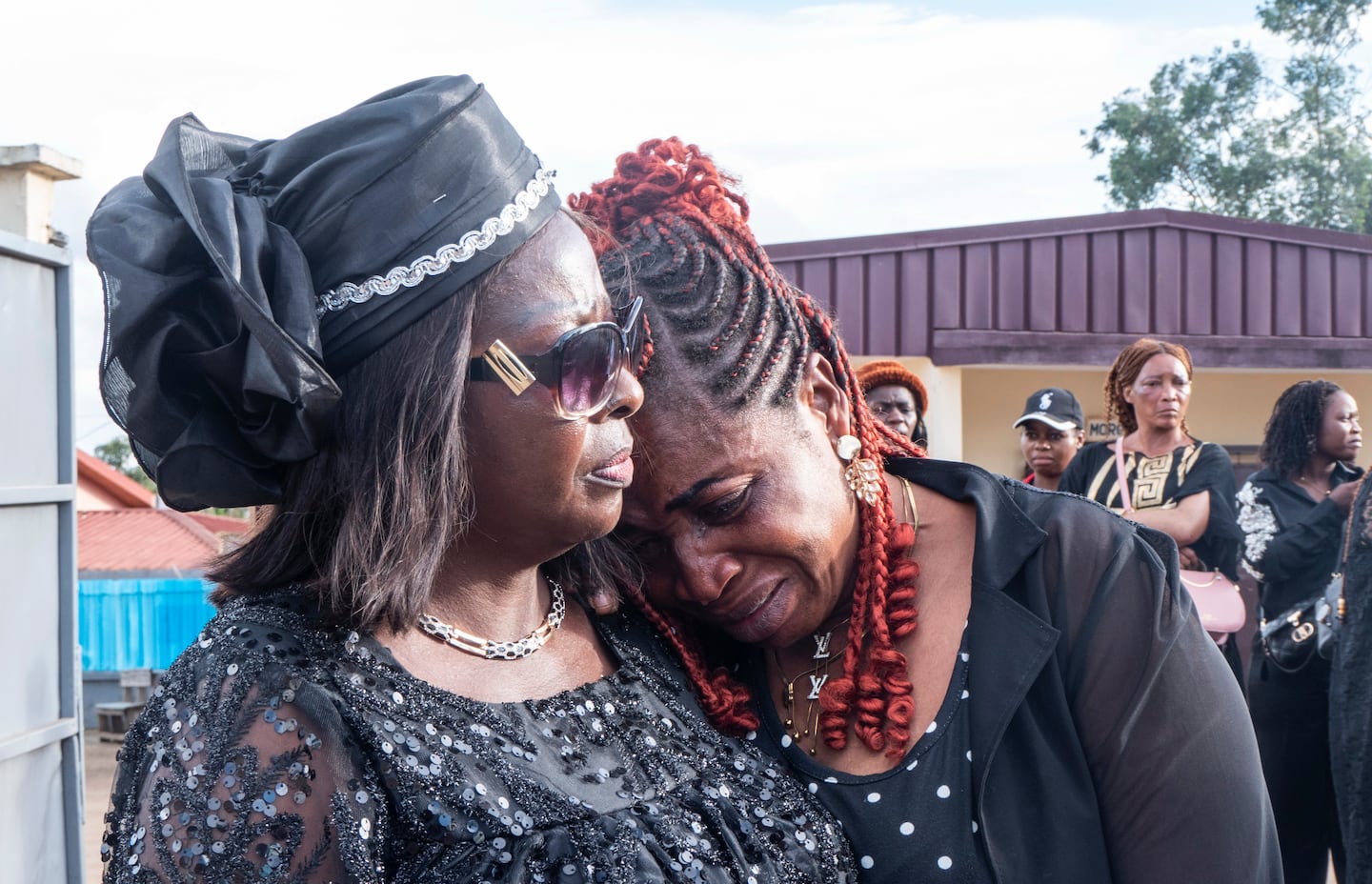
Photo credit: Boston Globe
Geraldine Achiah, an elementary school teacher in her 30s, died barely two months into her marriage in September. Her relatives allege her husband beat her over a marital dispute and demand justice in what they say is a gender-based crime.
The Associated Press reports that her only child, Courage Abombi, fondly remembers her support for his dreams of becoming a mechanical engineer. “My mom died an unexpected and painful death,” said Abombi, who had to take a university entrance exam a day after his mother’s burial.
Nearly 70 women have died in Cameroon this year for reasons related to their gender, the Ministry of Women’s Affairs says. That’s up from government estimates of at least 50 in 2023 and 67 in 2024. The rise in such killings has sparked protests and calls for government action, as many of the killings remain unsolved while others go unreported.
Manfred Amambua, Achiah’s husband, has denied killing his wife, the police said, while his lawyer wasn’t available for comment. He has been charged with murder and is in jail awaiting trial.
Femicide – the killing of women and girls for gender-related reasons – in Cameroon is mostly driven by economic dependence, unequal control over family property and lack of adequate laws in what’s widely viewed as a patriachal society, activists say. The crisis reflects a global pattern with an estimated 50,000 women and girls killed by intimate partners and relatives in 2024, UN data shows.
Femicide cases in Cameroon have reached a “cruel” and “alarming” proportion, Women’s Affairs Minister Marie-Therese Abena Ondoa recently told the state broadcaster as she promised more action from the government.
At the root of the matter is inadequate laws to punish offenders and a poor juducial aystem. activists say. While Cameroon’s Penal Code recognizes crimes su ch as rape, it does not have explicit laws or provisions on femicide, leaving judges to rely on general laws on harmful acts.
It is a common trend across many African countries where femicide is addressed through general honmicide laws rather than expressly defining it as a distinct offence, although some have taken limited legal or policy steps that ac knowledged femicide.
The Cameroonian government is working on a new bill that would establish femicide as a standalone crim inal offence while also strengthening broader protections against gender-based violence. For rights groups and activists, that is only one of several hurdles to stop the killings.
Anti-femicide protests have been held in major cities in the country, including Douala and Yaounde, with thousands demanding more action from the government.