Photo credit: AP News
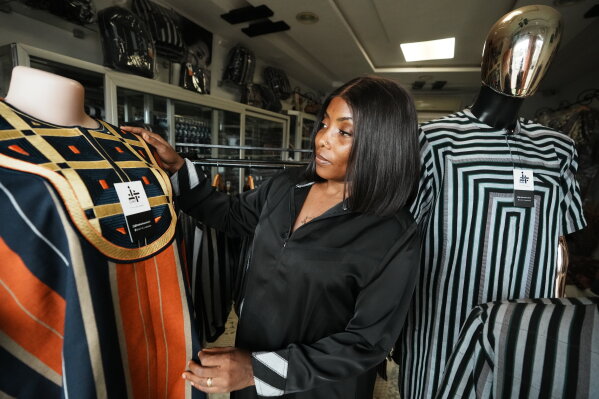
The “Made in Benin” tags on Fatoumata Dosso’s fabrics represent an ambition much bigger than her fashion business: keeping more of the value of Africa’s largest cotton producer at home.
The Associated Press reports that the founder of DAF Collection said that the tag means her country is trying to take full advantage of the abundant raw material produced in Benin. For her, there is also the opportunity to support more women in her community wh hope to earn a living from cotton.
“I am more focused on promoting the traditional fabric of northern Benin,” she said inside her showroom in the northern city of Parakou. “What comes from elsewhere is already everywhere. I wanted to do something special.”
Dosso is responding to government policy that discourages the export of raw material and stipulates that the West African country must do more to export finished products – from pineapple juice to garments marketed by world-famous brands, but still marked with Benin.
Benin is Africa’s top cotton producer, according to data from US Department of Agriculture, benin produced 1.15 million bales of cotton between 2025 and 2026, accounting to 0.9% of global production.
That sounds like a tiny share of the global market – by comparison, China produced 35.8 million bakes in the same period – but cotton has long been the top cash crop for Benin, its primary export. The country is still betting on cotton for years to come, weven as production has been in decline in eastern and southern Africa.
Benin, which had been exporting almost all its raw cotton to Bangladesh, moved toward value addition in 2020 with a private-public partnership involving the infrastructure developer Arise IIP.
The deal established the Glo-Djigbe Industrial Zone, or GDIZ, where young Beninese workers can be found processing pineapples, cashew nuts, ceramics and other export goods.
GDIZ processes about 40,000 tons of Beninese cotton to produce between 7 and 10 million garments annually. The expansion of the GDIZ and shifting exports toward finished products helped reduce Benin’s current account deficit – when a country sends more money for goods and services abroad than it receives back – from 6.2% of gross domestic product in 2024 to 5.7% in 2025, according to the African Development Bank.
Associated Press journalists recently toured the garment section of GDIZ, a hive of activity as station managers surveyed employees doing the work that goes into making garments:: straightening collars, stitching buttons and pressing T-shirts with flat irons and folding them delicately. Garment makers like US Polo Assn. and Kiabi were represented.
Souhaibou Gambari, executive secretary of a national association of cotton producers in Benin, told AP: “Beyond farm operators alone, the cotton sector directly or indirectly supports the livelihood of more than 2 million people in rural areas, making it the leading driver of social inclusion in Benin’s farming communities.”
“I was in a region where women were learning cotton weaving, but they didn’t have a market for their products,” said Dosso, who quit her job as a private secreyary to the mayor of the northern town of Gogounou to focus solely on the fashion business that she started in 2016.