Photo credit: the Borgen project
Migration is the heartbeat of human history. From early nomadic movements that populated continents, to the Silk Road networks that connected civilizations, to the maritime expansions of the Renaissance, human mobility has been the primary engine through which ideas, technologies, and cultures have spread. Cities such as Lagos, Cairo, London, and New York did not emerge in isolation; they are the accumulated expression of human movement, concentration of talent, and cross-pollination of innovation.
The Vanguard reports that migration, in its historical sense, built civilization. However, what we are witnessing today is not the continuation of that historical rhythm but a profound mutation of it.
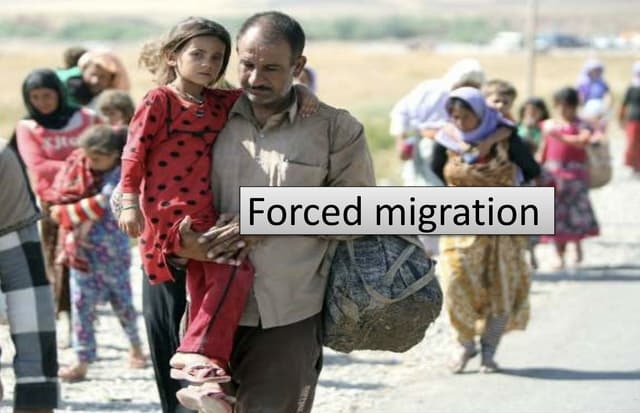
We have entered the era of forced migration, a condition that signals not expansion, but structural stress within societies.
While global attention often focuses on refugees fleeing war, persecution, or climate disasters, a quieter and more pervasive form of displacement is accelerating among many developing nations. It is not driven by sudden catastrophe but by the gradual erosion of functional systems that make human life economically viable.
When migration becomes a prerequisite for survival, it ceases to be an act of aspiration and becomes a form of escape.
In many societies, the social contract has weakened significantly. Young graduates enter the workforce only to discover economies with limited absorption capacity. Entrepreneurs confront unpredictable regulation, unstable infrastructure, and high operational friction. Skilled professionals encounter systems where effort is no longer reliably rewarded.
Under such conditions, migration becomes a rational decision rather than a personal ambition.
The deeper tragedy, however, is not the movement of people itself but the systematic depletion of human capability from the societies they leave behind.
When engineers migrate, infrastructure systems lose maintenance capacity. When doctors leave, public health systems weaken. When teachers depart, knowledge transmission declines. When entrepreneurs relocate, innovation systems collapse. What is occurring is not simply “brain drain,” a term that implies temporary loss. It is the erosion of institutional memory and productive intelligence.
A society is not sustained by population size alone but by the density of functioning human capability embedded within its systems. Once that density begins to thin, a feedback loop emerges; declining capacity produces weaker systems, and weaker systems produce further migration.
This is how structural decline accelerates itself.
In many cases, governments attempt to interpret migration through financial indicators, particularly remittances. Indeed, remittances provide vital support to households and stabilize consumption in the short term.
But this creates a dangerous illusion. Remittances may sustain families, but they do not rebuild systems.
A society that relies structurally on exporting its human capital while importing financial inflows risks converting its most valuable asset-its people-into an externalized economic function. Over time, this produces a dependency loop in which survival is maintained, but systemic development is weakened.
The core issue is not migration itself. Human mobility has always been essential to global development and innovation.
The issue is compulsion. Why is migration increasingly becoming a necessity rather than a choice? The answer lies in governance and system design.
This is an abridged version of an article written by Dr Victor-Bandele Dada