Photo credit: Global Sisters Report
A nun in a blue veil sweeps fallen leaves at Queen Memorial Circle. Around her, couples linger on benches. It’s not the kind of place where one would expect to find a religious sister at work.
A report in the Global Sisters Report states that one day, a nun from another congregation saw her and began to cry.
“Why are you working here? There’s so much temptation.”
The sister sweeping that day was Sr Cecelia Grace de Jesus of the Little Sisters of Jesus of the Philippines.
For the congregation, that tension – between contemplation and immersion – is something to embrace, not avoid.
“If you work in a factory, you run after the vehicle just to get there on time,” Sister Cecelia Grace said. “There is noise. There is pressure. You hear everything – how people talk, how they struggle.”
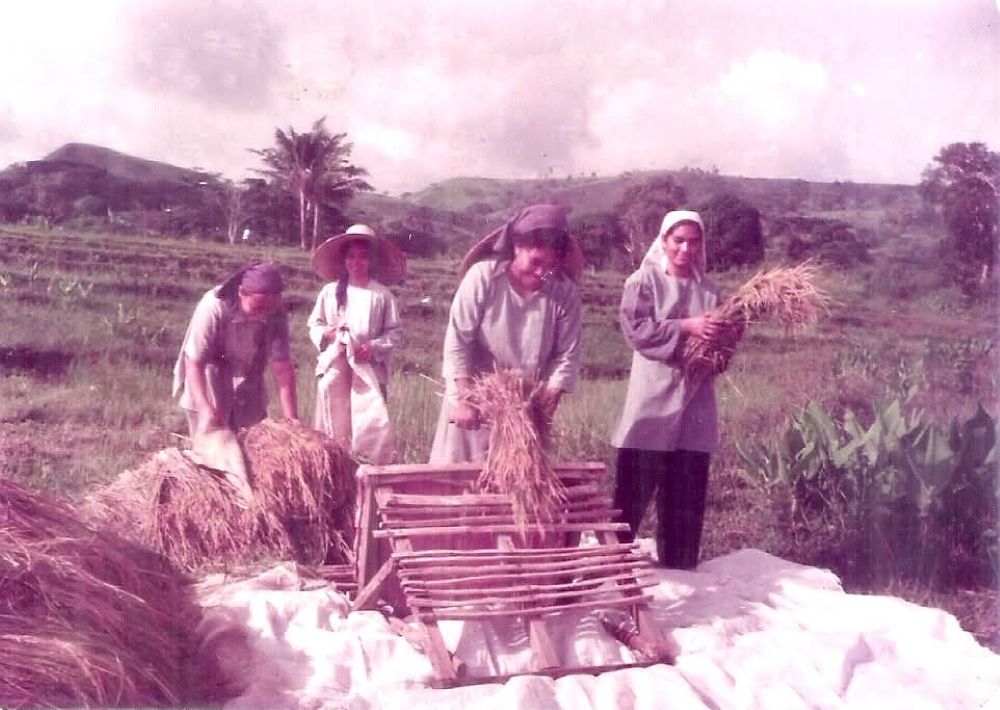
For the past 50 years, they have worked in bakeries or taken factory shifts, and, when the season came, bent under the sun to harvest rice. At times, they stepped in as a family’s house help when the regular help was away. When factory work was scarce, they took in laundry. At a glance, they were indistinguishable from the women around them – except for the veils.
This was by choice. Rather than live apart in convents, the sisters chose to settle in poor communities – slum areas in Manila and rural villages in the provinces – making their homes among workers and their families so they could share in the realities of daily life. The spirituality of Charles de Foucauld shapes this approach. Presence, they believe, is not measured by visible results but by a quiet, faithful closeness to others.
“In the convent, everything is provided,” added Sr Maria Elizabeth de Jesus. “Here, you move with the flow of the world. You feel the tiredness of workers. Sometimes, you fall asleep in the chapel because you are so tired.”
That fatigue is foemative. It sharpens their awareness of injustice – low wages, inequality and the fragility of everyday life.
Their presence, even when quiet, can shift a workplace.
Working alongside labourers also changed how they understood the Gospel.
“It helped me to go deeper – not with my head, but with the heart,” said Sr Annarita de Jesus, an Italian sister, “Jesus spent many years in Nazareth. He learned to speak a language ordinary people could understand.”
That same insight emerged in the fields. In rice paddies, young shoots were almost indistinguishable from weeds.
The same was true in the lives around them. Stories of broken families and reconciliation gave new depth to the prodigal son.
“You see forgiveness, acceptance,” Sister Maria Elizabeth said. “if I did not experience this, I would not understand the Gospel deeply.”
Living as workers has also brought moral tension.
In one factory, workers were tasked with replacing labels on cheap clothing to pass them off as branded. Sister Maria Elizabeth refused. “It was a deception,” she said.
Even dignity itself had to be relearned. Sister Cecilia Grace recalls being recognized by a former classmate while working as a sweeper. “She asked me, ‘Is that really you?’ I felt ashamed.”
The moment forced her to confront her assumptions.
“Dignity is not based on work,” she said. “Every person has dignity.”
For Sister Annarita, poverty and dignity are not opposites.
Their presence in communities sometimes drew suspicions as much as trust.
While living among farmers in Antipole in rural Philippines, the sisters came under surveillance. Their house was searched for weapons, and they were suspected of being members of the New People’s Army. At the same time, some neighbours assumed the opposite – that the sisters shared their cause.
The sisters also found themselves drawn into a fight to protect the community’s water supply. “Treasure hunters had been cutting trees across the area, and one large tree – vital to the water source of nearby residents – was next. The sisters opposed its removal.
“They pointed a gun at us,” Sister Elizabeth recalled.
The sisters stood their ground, pleading with them not to resort to violence.
Yet, beyond these moments of resolve lay a more difficult reality.
Not every effort led to visible change. Attempts to support workers seeking better wages were sometimes met with indifference. But for the sisters, accompaniment is not measured by results.
“Journeying with others doesn’t produce results you can measure,” Sister Annarita said. “The fruits belong to the mystery of God.”