Photo credit: Daily Galaxy
For generations, women in southwest Morocco’s Ait Baamrane region spent up to four hours a day walking to wells and hauling back five-gallon barrels of water on their heads.
Europe Says reports that each barrel weighed nearly 50 pounds. The task consumed their mornings, kept girls out of school, and shaped every household routine along the edge of the Sahara.
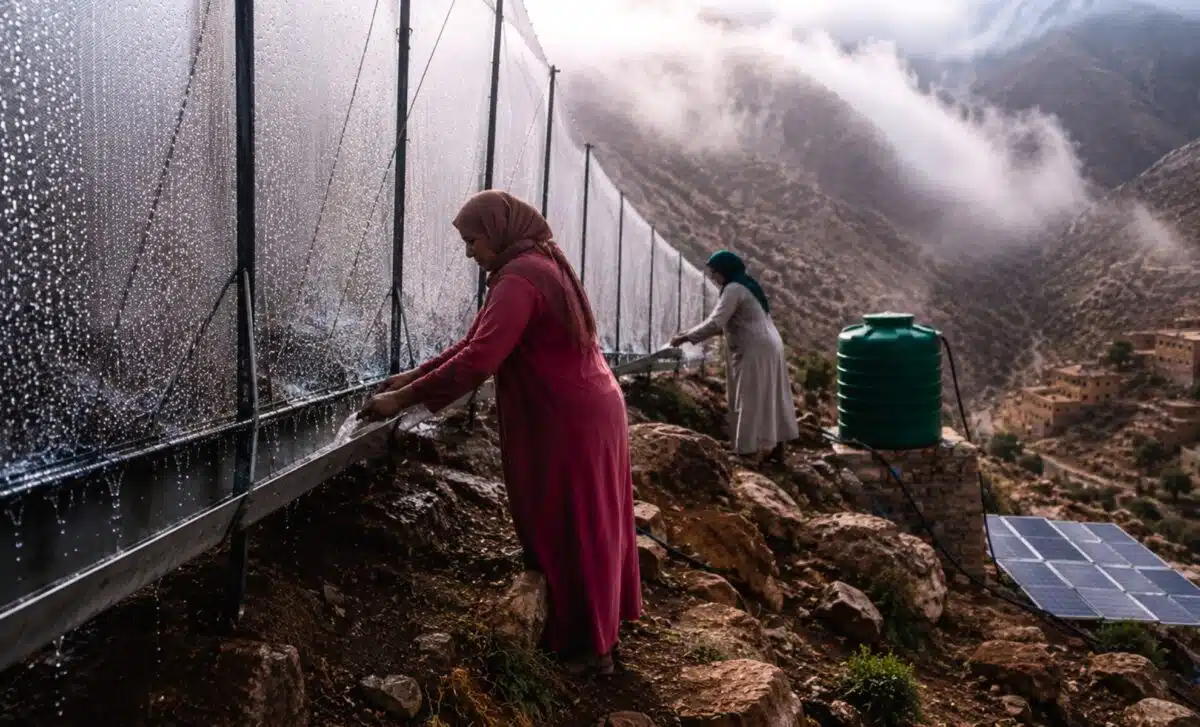
But that changed when giant polymer nets appeared on the slopes of Mt Boutmezguida.
Suspended from steel poles at more than 4,000 feet, the nets trap moisture from Atlantic fog as it sweeps through the Antip-Atlas range. The captured water drains into reservoirs, flows through gravity-fed piping, and now reaches village taps more than 10 kilometres away. No wells. No motorized pumps. Just mesh, elevation, and the humidity already moving through the air.
The project was highlighted in mid-May 2026 by the UNFCC, the United Nations entity on climate change, which recognized the system as a working model of climate adaptation in a region squeezed by centuries of desertification.
The principle behind fog collection is straightforward enough to have appeared in sixteenth-century writings. Bartolomé de las Casas described similar techniques in his History of the Indies. Modern engineering has made it far more effective.
Gareth McKinley, a professor of teaching innovation at MIT’s School of Engineering, explained what changed. “By changing the size of the holes, and the size of the fibres, we’ve improved the fog-collecting efficiency by about five hundred per cent,” he told The New Yorker. The polymer nets on Mt Boutmezguida can collect up toi 12 gallons of water per square yard of netting in a single 24-hour period.
The installation uses 600 square metres of nets. Solar panels handle the system’s minimal energy needs. Durable materials make the equipment reparable by local residents, an improvement over earlier fog-collecting installations tested in Eritrea, Chile, and Yemen during the 1990s and early 2000s.
The UNFCCC’s recognition in 2026 brought renewed attention to fog harvesting at a moment when aquifer depletion is worsening across North Africa and coastal regions globally. The World Health Organization estimates that a community requires about 20 gallons of water per person per day for residents, crops, and livestock to thrive. A single modest installation can meet that threshold for a village.
The numbers are striking in human terms too. In Africa alone, women spend an estimated 40 billion hours a year fetching water. The pipeline system in Morocco erases that bureau for the families it reaches.
But fog harvesting is not a universal solution. It demands consistent fog, specific topography, and high elevation. The Saudi Arabian government recently spent $7.2 billion on a desalination plant on the Persian Gulf, a reminder that arid regions with coastlines but no foggy mountains still require entirely different approaches.
The nets on Mt Boutmezguida function because the Anti-Atlas range regularly traps Atlantic moisture at altitude. The system has now been running long enough to prove that a visually simple structure, polymer mesh stretched between poles on a remote ridge, can solve a water scarcity problem that wells, trucks, and desalination could not.