Photo credit: Euro News
Egypt is pressing Europe to share more of the cost of hosting what Cairo says are millions of refugees and migrants, as the EU weighs its dependence on a country it sees as a crucial buffer against irregular migration across the Mediterranean.
Euronews reports that the two sides are not short of bargaining chips over each other; Europe needs Egypt to keep irregular migration in check while Egypt needs |European money to manage a refugee crisis it says is costing more than 8.5 billion euros a year, according to experts.
The issue has become more urgent as humanitarian agencies warn of widening funding gaps in Egypt, where the war in Sudan has added to a long-standing refugee and migrant population that also includes Syrians, Palestinians, South Sudanese, Eritreans, Ethiopians, Yemenis, Somalis and Iraqis.
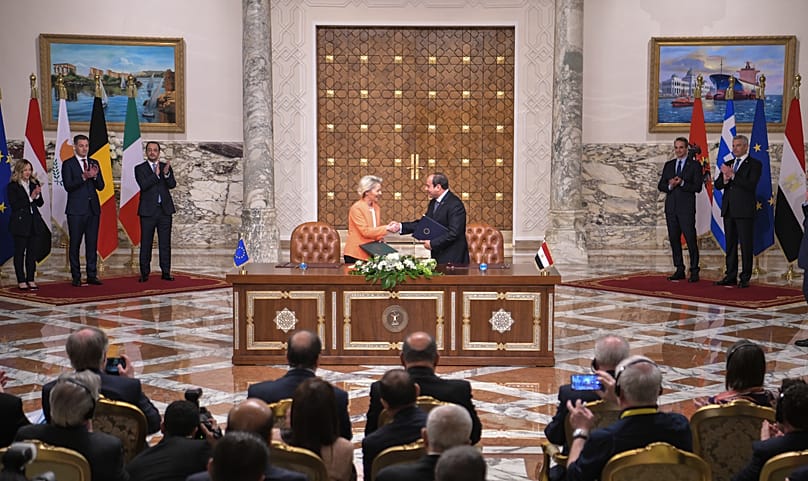
In 2024, the EU and Egypt elevated their relationship to a Strategic and Comprehensive Partnership covering political relations, economic stability, trade and investment, migration and mobility, security and people and skills.
Brussels then announced a 7.4 billion-Euro financial package for Egypt for 2024-2027, including 5 billion Euros in concessional loans, 1.8 billion Euros in additional investments and 600 million Euros in grants, with 200 million Euros earmarked for migration management.
The European Commission has framed the package as part of a wider range strategic partnership with Egypt covering economic stability, investment, migration and skills.
But the deal has been criticized by some MEPs and rights groups, who argue that the EU is expanding migration cooperation with Egypt without enough guarantees on human rights, asylum protections or accountability for alleged abuses.
Greens/EFA MEP Tineke Strik, a Dutch migration scholar and the European Parliament’s external dimension of EU migration policy in 2024, said cooperation with President Abdel Fattah al-Sisi would result in “more violence against migrants, more repression, and more dissidents fleeing the country.”
Mounir Satouri, a French MEP and the Parliament’s rapporteur for Egypt, criticized the broader regional approach at the time, which also included a deal with Tunisia, stating, “These are not the private funds of (then-Commissioner for Neighbourhood and Enlargement) Oliver Varhelyi. These are European funds.”
Speaking in April at a ministerial meeting of African countries leading implementation of the Global Compact for Migration, Egyptian Foreign Minister Badr Abdelatty said his country hosts “more than 10 million migrants and guests on its territory, who live within the fabric of Egyptian society and not in isolated camps, and enjoy basic services without discrimination.”