Photo credit: Pulse Nigeria
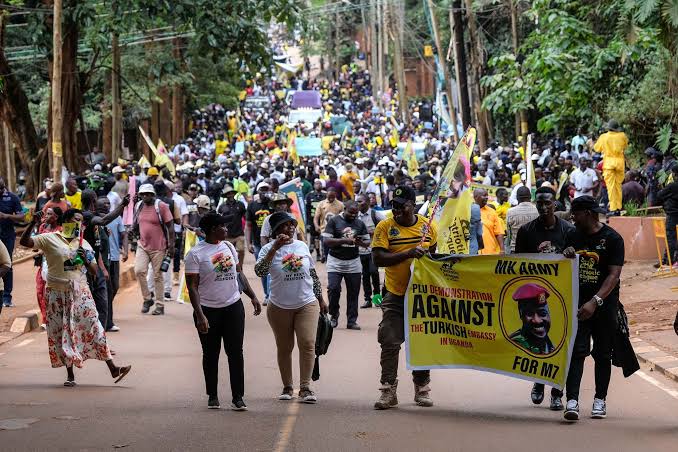
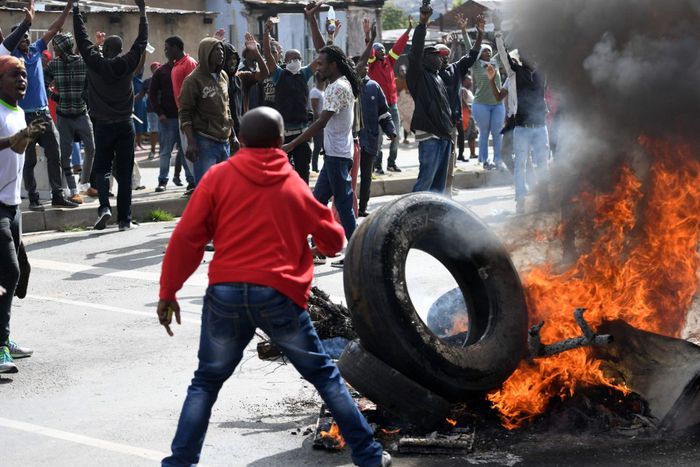
That South Africa has embarked on its disappointing project of Afrophobia is no news. Although the government of the country and various bodies have distanced themselves from the dreadful act which its proponents say is against illegal migrants, since the government has more or less lost its voice and the security forces have generally chosen to look the other way, the government should receive the blame.
The African states whose nationals are being driven, in most cases in humiliation – if not killed – from South Africa – are, more or less, in a state of shock.
For the purpose of brevity, I will use Nigeria’s reaction as an example.
Nigeria as a state and a few Nigerians have reacted rather disappointingly to the situation in South Africa.
There is something tragic about watching these two so-called giants of Africa slowly exhaust their moral authority in different ways.
One burns with anger from below while the other decays from indifference above.
In South Africa, frustration increasingly spills onto fellow Africans through waves of afrophobic violence. While this is disguised under softer labels such as “xenophobia,” but the targets are overwhelmingly black Africans.
Meanwhile, in Nigeria, outrage erupts in speeches, online fury, and diplomatic posturing, but often without the institutional seriousness necessary to confront either the roots lof the problem or Africa’s broader crisis.
Both states are claiming continental leadership while simultaneously exposing the fragility beneath their national myths.
South Africa presents itself as the economic powerhouse of Africa, the constitutional democracy that overcame apartheid and emerged as a global symbol. Nigeria also presents itself as the “Giant of Africa,” a demographic and cultural superpower with continental reach.
But their so-called claims to continental leadership are flawed. While one struggles to protect Africans from mobs, the other struggles to protect its citizens from despair.
The end of apartheid carried enormous psychological expectations. Political freedom was expected to quickly produce economic transformation. For many black South Africans, liberation was not merely about voting rights, it was imagined as a pathway toward prosperity, dignity, employment, land, and social restoration.
However, history rarely moves with revolutionary speed.
Years after apartheid, inequality remains in the country, unemployment remains devastatingly high. Violent crime remains pervasive. Infrastructure strains under pressure while public frustration deepens.
The migrant is therefore scapegoated.
Especially the African migrant who becomes a visible symbol onto whom deeper frustrations are projected.
I wouldn’t be surprised if after this round, the average South African marcher seeing his conditions have not improved, descends on the papered migrants.
What makes the South African case particularly painful is its historical irony.
During the apartheid era, many African states – including Nigeria – materially and diplomatically supported the anti-apartheid struggle. African solidarity was not merely symbolic. Countries sacrificed resources, scholarships, diplomatic capital and economic opportunities to isolate the apartheid regime.
However, South Africa seems to have conveniently forgotten African solidarity in ending apartheid and it has resorted to hunting African immigrants in the streets.
A society certain of its economic direction does not descend into periodic civilian cam;paigns against vulnerable migrants.
Nigeria’s response to South African afrophobia is often emotionally satisfying but strategically shallow.
After the anger whenever videos emerge of attacks against fellow Africans in South Africa, politicians issuing condemnations, eruption of social media, brief calls for boycotts and flaring of do[lomatic tensions, an eerie normalcy returns.
Like South Africa, Nigeria is struggling from mass unemployment, infrastructural collapse, mass poverty, and elite corruption. Nigeria is also struggling with a high level of insecurity. So, Nigeria is not in a good position to regard itself as the moral custodian of African dignity unless it fixes its own domestic failures.
The question Nigeria should be asking itself is why so many Nigerians are ready to jaapa, even to the Arab countries.
A country hemorrhaging human capital cannot entirely separate itself from internal governance failure.
Of course, this does not excuse attacks on migrants. Nothing justifies mob violence, aka jungle justice.
Is it not ironic that Nigeria is condemning South Africa while millions of Nigerians endure kidnapping, terrorism, collapsing public services, unemployment, and institutional distrust at home?
The contradiction is so glaring that it weakens Nigeria’s continental posture.
I would rather both countries concentrate on providing jobs, electricity, potable water, roads, and other basic amenities for the people.
This essay does not mean the two states are identical. They have different histories, economies and institutional capacities.
However, both reveal a larger African crisis; the widening gap between political symbolism and lived reality.