Nine countries currently either say they have nuclear weapons or are believed to possess them.
The Mainichi of June 19, 2025, reported that the first to have nuclear arms were the five nuclear-weapon states – the United States, Russia, China, France and the United Kingdom.
All of them are signatories to the Nuclear Nonproliferation Treaty, which commits countries that don’t have nuclear arms not to build or obtain them, and those that do to “pursue negotiations in good faith” aimed at nuclear disarmament.
Other countries that have or are strongly believed to have nuclear arsenals over the years are: India, Pakistan, Israel, and North Korea. Iran long insisted its nuclear program is for peaceful purposes, and US intelligence agencies assessed that Tehran was not actively pursuing the bomb.
The five are not members of the NPT.
The Stockholm International Peace Research Institute estimated that the nine countries had the following stockpiles of military nuclear warheads as of January 2025:
Russia: 4,309
US: 3,700
China: 600
France: 290
UK: 225
India: 180
Pakistan: 170
Israel: 90
North Korea: 50
Scienceinsights says full-scale nuclear war between major powers would kill hundreds of millions of people in the first hours, then billions more in the following months and years from famine, radiation, and environmental collapse. The immediate blasts and firestorms would be catastrophic, but the longer-term effects on climate, food production, and atmosphere would cause far more death than the weapons themselves.
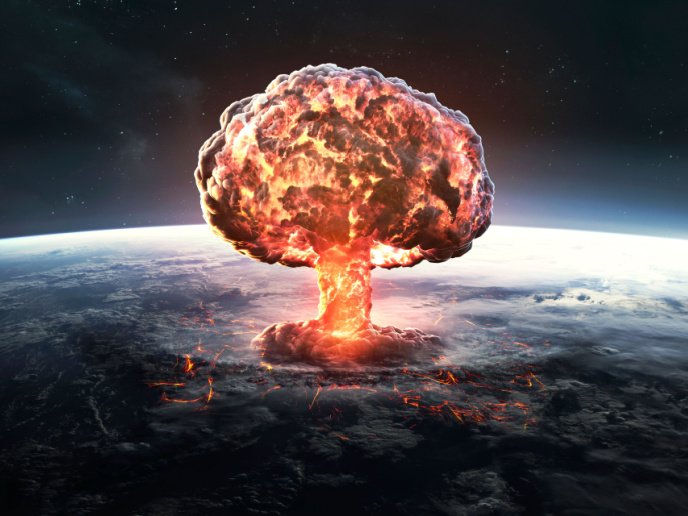
Modern nuclear warheads are primarily targeted at military installations, government centres, and infrastructure. Each detonation produces a fireball hot enough to ignite everything within several miles, a pressure wave that flattens buildings, and an initial pulse of radiation lethal to anyone nearby without heavy shielding. In a full exchange between the United States and Russia, which together hold 90% of the world’s nuclear weapons, hundreds of warheads would detonate across both countries and allied nations within the span of an hour or two.
People within the immediate blast zones would die instantly. Those farther out would face severe burns, collapsed structures, and radiation exposure. At doses above 6 gray (a unit measuring absorbed radiation), symptoms begin within 30 minutes: vomiting, severe diarrhea, high fever, and headache. Without advanced medical care, doses this high are alm for at least the first two days dramatically yed across wide areas. Most people with serious radiation injuries would go untreated.
Within minutes of each detonation, irradiated debris is pulled up into the mushroom cloud and begins drifting downward as fine, radioactive dust. This fallout can spread hundreds of miles, coating surfaces and contaminating water and food supplies. The danger is highest in the first 48 hours. A rule of thumb used in civil defence planning, called the 7:10 rule, helps illustrate the decay: for every sevenfold increase in time after detonation, the radiation exposure rate drops by a factor of ten. So if fallout produces 1,000 units of radiation per hour at one hour after the blast, it drops to about 100 at seven hours and 10 at 49 hours.
This means sheltering in a well-shielded building (basements, concrete structures, interior rooms away from windows) for at least the first two days dramatically reduces exposure. After two weeks, outdoor radiation levels from fallout drop to roughly 1% of their initial intensity. The practical problem in a full-scale war is that fallout zones would overlap across entire regions, and millions of people would have no access to adequate shelter, clean water, or uncontaminated food.
The firestorms ignited by hundreds of nuclear detonations would loft massive quantities of soot and smoke into the upper atmosphere. In a full-scale war, models estimate roughly 150 to 180 million tons of fine soot reaching altitudes of four to nine kilometres, where rain can’t wash it out. This black layer would absorb sunlight before it reaches the surface, cooling the planet dramatically.
Climate models suggest that in the northern temperate zone (where most of North America, Europe, and \russia sit), surface temperatures could drop by around 20 °C during the weeks following a summer exchange. That’s a plunge from normal summer temperatures into conditions well below freezing. Smaller but still significant temperature drops of several degrees could reach the tropics and even the southern hemisphere, persisting for various months to years depending on how much soot remains aloft. The term “nuclear winter” isn’t hyperbole. Growing seasons across most of the planet’s agricultural regions would effectively disappear.
The collapse of agriculture would be the deadliest consequence of nuclear war by a wide margin. Modelling by researchers at |Rutgers University traced the effects of reduced sunlight and temperature on global harvests of corn, rice, wheat, soybeans, and fish. Their findings are staggering: a few years after a full-scale war between the US, its allies and Russia, global calorie production would drop by roughly 90%. An estimated 5 billion people would die from the resulting famine, far exceeding the hundreds of millions killed directly by weapons.
Even a smaller regional nuclear conflict would cause global food crises. A war between India and Pakistan, involving a fraction of the world’s arsenals, could cut global calorie production by 50% and cause an estimated 2 billion deaths. Corn yields alone could fall by 7% after a regional exchange or by 80% after a large-scale global war, according to modelling from Penn State. These aren’t localized shortages. Because modern agriculture depends on stable climate patterns and international trade, disruptions to growing seasons in one hemisphere ripple across the entire food system.
Stockpiles of grain and preserved food would buy some time, but global reserves typically cover only a few months of consumption. Countries that depend on food imports would face crises almost immediately. Even nations with domestic food production would struggle as cold temperatures, reduced sunlight, and disrupted supply chains made farming nearly impossible for years.
X Ozone destruction and ultraviolet radiation
X Collapse of the ocean ecosystem
The combined picture of the world is one of cascading systems failure. The initial explosions destroy cities and infrastructure. Fallout contaminates vast stretches of land. Soot plunges the entire planet into years of cold and darkness. Agriculture collapses. The ozone layer has thinned to a fraction of its normal protection. Oceans become more hostile to the organisms at the base of the food chain.
Survivors in the southern hemisphere, farther from the primary targets, would have the best chances, but they would still face dramatically reduced temperatures, crop failures, dangerous UV exposures, and the collapse of the global trade. There would be no imports of fuel, medicine, fertilizer, or machine parts. Electrical grids, communication networks, and transportation systems in affected regions would be destroyed or inoperable. The world that emerged afyer a decade of recovery would support a fraction of its pre-war population, with most of the infrastructure of modern civilization gone.