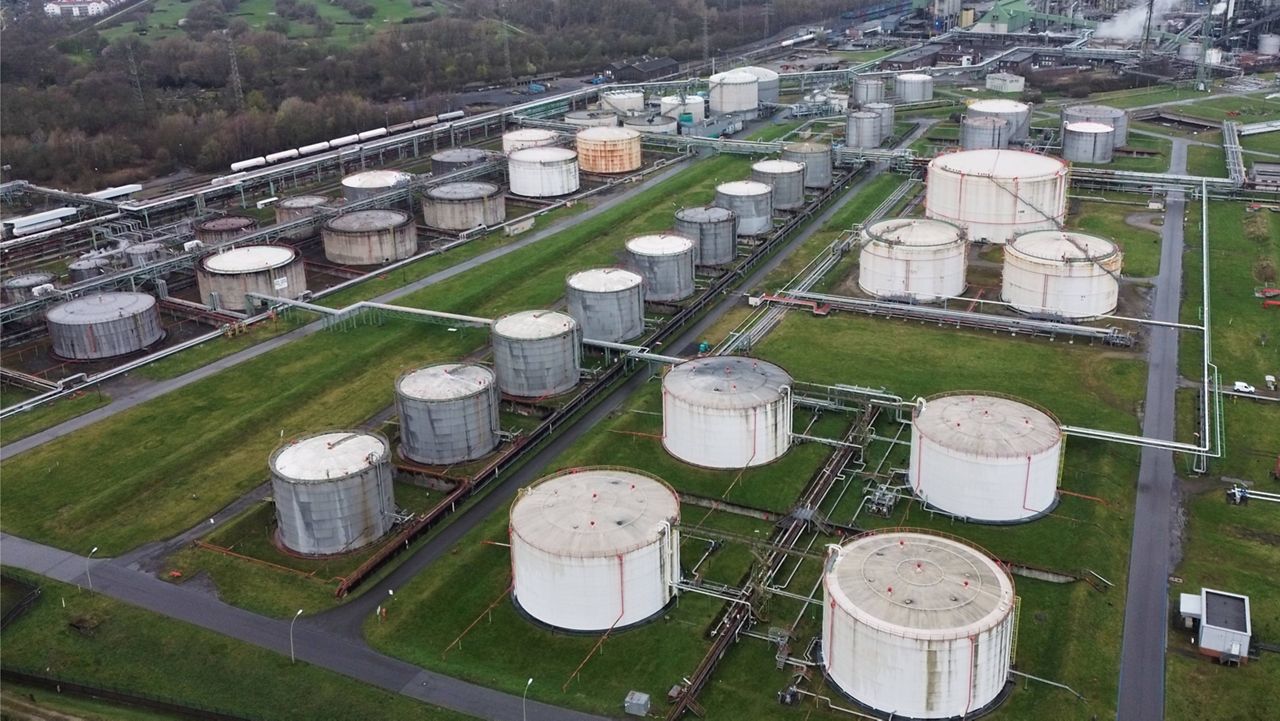
Photo credit: Spectrum News
Governments around the world agreed to release 400 million barrels from emergency oil reserves to ease surging global energy prices on Wednesday.
Bloomberg reports that it’s the largest discharge ever made by the International Energy Agency. With that amount of oil, one could theoretically fill 25,000 Olympic-sized swimming pools of 20 NFL stadiums, fuel a commercial aeroplane for roughly 50 years of continuous flight or cover the entire surface of Manhattan with about 3.5 feet of oil.
The IEA’s decision to utilise its services underscores the severity of the situation unfolding near the Strait of Hormuz. While US minesweepers race against time, commercial ships are coming under attack from Iran in the waterways.
The war is now stretching far beyond the strait, though. While disruptions to global commerce are hurting some businesses, others are taking advantage of the chaos. At the risk of minimizing the very real, very gruesome realities of the war, winners and losers are already emerging.
On the winning side sits Latin America. According to Goldman Sachs, persistently higher oil prices could translate into higher growth for the region. “The impact, of course, won’t be uniform,” notes Juan Pablo Spinetto: “Large net exporters such as Brazil, Guyana or Colombia stand to benefit far more than major importers of fuel and natural gas like Mexico and Chile.”
Amazon’s Marcus Ashworth says it’s “quite something” that the e-commerce behemoth was able to pull off a mega bond sale in such volatile times. “In an otherwise turbulent market, large-scale bond deals like Amazon’s are great fee earners for the investment banks arranging them as well as for investors piling in at attractive yields.”
Among the losers is the “sell America” trade. Jonathan Levin says the argument that foreign capital was fleeing the US has proven to be rather flimsy in the war. “America is still the go-to market for investors,” he writes.
Asia, on the other hand, is in bad shape. “The region has been dealt a significant blow,” writes Daniel Moss. “Many of Asia’s major economies are big importers of oil and are dependent on unfettered sea routes for the exports that have powered economic development and remain critical in their growth models.”
Also dependent on oil: tourists and airlines. “Given the human tragedy unfolding in the Middle East, and the spiralling economic cost from rising oil prices, wondering about the impact on vacations might seem distasteful. But tourism is a crucial part of the success of places like Dubai,” writes Andrea Felsted. Money is fleeing the UAE, amid a corporate exodus, and many financiers may not return.
Longer term, Thomas Black warns that “airlines have nowhere to hide from an oil-price spike. They sell directly to the consumer. Carriers either eat the expense or pass it along, knowing that higher airfares dampen demand. That demand destruction could mean that price increases don’t turn into higher revenue.” Those 400 million barrels of crude may help ease some aviation woes, but for how long?