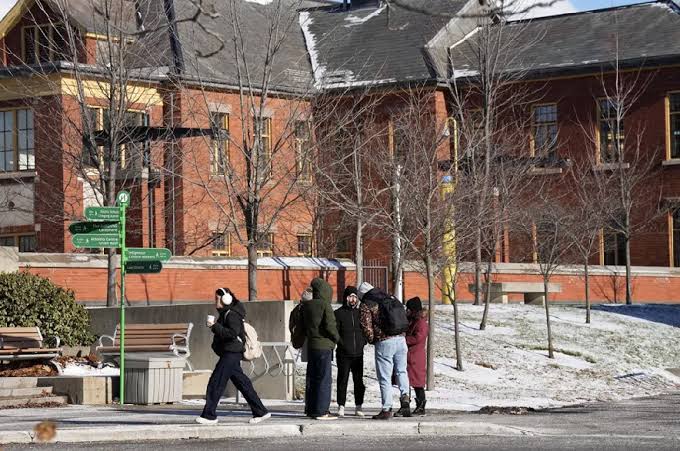
Photo credit: CTV News
The World Happiness Report says Canadians under 30 were the happiest age group in the country as recently as 2011.
Toronto Today reports that they’re the unhappiest now.
The 2024 edition of the decades-long study of global happiness, published by the Wellbeing Research Centre at the University of Oxford, asked participants to picture their life as a ladder, with the best possible life at 10 and the worst at zero.
While many countries among the 134 covered by the research have also seen happiness levels fall among those under 30 since 2006, the slide of young Canadians down the ladder is exceptional.
Only four countries have seen a worse decline – Jordan, Venezuela, Lebanon and Afghanistan.
Yet, over all age groups, Canada ranked the 15th happiest country in the 2025 report, which did not contain the same level of detail about young people as last year’s report – Canada ranked 18th.
Anthony McCanny, the lead author of the separate 2024 Canadian Happiness Report, published by the University of Toronto’s Population and Well-being Lab, said young Canadians are reconfiguring expectations.
He said, “We had a vision about what becoming an adult meant in terms of your job, and your financial security and having a home.
“Exactly what it looks like to reach that later stage of life is changing.”
Young people across Canada interviewed by The Canadian Press described the challenge of building lives they once imagined, bogged down by an affordable housing market, struggles to save for the future, online gloom and a growing youth mental health crisis.
Ontario graduate Thivian Varnacumaaran, 25, applied for more than 400 jobs before finding work and considers living with his parents a privilege.
Fitness instructor Taylor Arnt of Winnipeg, 27, said she’s processing the idea she might never get married or have children, as she grapples with everyday challenges.
Communications CEO Kathryn LeBlanc, 31, spoke of the demands of the 24-hour news cycle.
Some in a BC mental health program told of limited support.
Many also spoke of finding ways to be happy in the moment, even if their lives haven’t yet turned out the way they pictured.
“I am happy, yeah,” said Sharma. Family, friends, vacations and balancing work expectations bring him joy.
“I try to stay positive.”
Before 2014, well-being in Canada could be broadly described as a U-shaped trajectory. Satisfaction was high among youth, declined to a low point in mid-life, then rose again as people got older.
John Helliwell, an emeritus professor of economics at the University of British Columbia and a founding editor of the World Happiness Report, said that U-shape is no more.
Helliwell said social and economic conditions are not seen by today’s young as promising, unlike previous generations.
In 2023, the Bank of Canada’s housing affordability index hit its worst level in 41 years. While it has eased, it remains at levels akin to the early 1990s, when interest rates were more than nine per cent.
The situation has been acute for the young.
Statistics Canada says the average age of marriage has steadily increased, from 25 in 1968 to 35 in 2019. (Data since has been skewed by the COVID-19 pandemic, which StatCan says saw many delay marriage plans).
Over the same period, the agency says the average age of first-time mothers rose from 22 to 29, while the average age of all mothers rose to nearly 32 in 2024, up from almost 27 in 1976.
Following the release of the 2024 World Happiness Report, Canadian researchers looked closely at the numbers and confirmed the findings.
But they say the size of the happiness decline among young Canadians could depend on how they were questioned.
McCanny, lead author of the Canadian Happiness Report, said the global study asked people to compare their current life to the best possible life they could be living.
When Statistics Canada asked Canadian youth how satisfied they were currently, the decline in happiness was significantly less dramatic, he said.
Statistics Canada’s Community Health Surveys found a modest decline in satisfaction for young people from 8.2 in 2015 to 7.9 in 2021, the Canadian report said.
McCanny, 32, called the differences in question a thin but possibly significant distinction. He said the age group may be “just in flux.”
“We are adapting to a new way the world is, which certainly can be very hard to do. But also, when we do ask people if they feel satisfied with their lives, they also say yes,” he said.
Helliwell also said the speed at which happiness has declined is a sign that it can be improved.