Photo credit: The Guardian
Hundreds of thousands of migrants from Haiti, Venezuela, and elsewhere risk their lives each year to cross the Darien Gap between Colombia and Panama.
The Darien Gap is an imposing obstacle on one of the world’s most dangerous migration routes. The remote, roadless crossing on the border between Colombia and Panama consists of more than sixty miles of dense rain forest, steep mountains, and vast swamps. It is the only overland path connecting Central and South America. Over the past few years, it has become a leading transit point for migrants in search of work and safety in the United States, as authorities have cracked down on other routes by air and sea.
However, migrants face many challenges on this land journey northward, including treacherous terrain, exposure to disease, and violence at the hands of criminal groups. As the number of migrants grows – with more than half a million making the trek in 2023 – so too does the impact on the Indigenous communities whose lands they often traverse. International aid organizations have sought to manage the crisis by setting up temporary housing and providing basic services to those arriving in Panama, even as the Panamanian government has announced new measures to crack down on migrants and asylum seekers entering the country.
Economic insecurity, political upheaval, violence, and climate change are driving tens of millions of people from their home countries, according to World Bank experts. At the same time, the lifting of COVID-19 border restrictions has reopened many travel routes across Latin America. Most migrants are ultimately headed for the southern US border, where they hope to receive asylum. But many coming from the Caribbean and South America first have to cross the sixty-mile-wide Darien Gap, the only break in the Pan-American Highway that otherwise stretches uninterrupted from Alaska to the southern tip of Argentina.
According to the Panamanian government, a record number of more than 520,000 migrants crossed the Darien Gap en route to the United States in 2023, over double the number reported the year before and up from just a couple of hundred people annually a decade ago. Approximately one-fifth of those who made the crossing were children. While the majority of migrants were from Venezuela, followed by Ecuador and Haiti, some hailed from as far away as Angola, Bangladesh and Pakistan.
Experts say the number of people risking their lives to cross the gap is expected to increase as socioeconomic conditions worsen across the region. Since a devastating earthquake rocked Haiti in 2010, for instance, tens of thousands of Haitians moved to South America, where they have faced discrimination and economic difficulties. In 2021, 61 per cent of migrants traversing the Darien Gap were from Haiti. That number dropped to about 9 per cent in 2023, though the country continues to endure gang violence, political instability, and the effects of frequent natural disasters. Meanwhile, the number of Venezuelans crossing the gap has sharply increased as the humanitarian situation in their home country grows more dire.
The first stop on the journey north is the coastal town of Necocli, Colombia, on the shore of the Gulf of Uraba. Most migrants already in the region travel on foot or take local transportation to get there. But for those coming from Africa and the Caribbean, the route is more complicated. Under mounting pressure from the United States to contain illegal immigration, the Mexican government has expanded its visa requirements, making it more difficult for people to fly directly to the US-Mexico border. Instead, they will now often fly into Brazil or Ecuador, where visa policies are more lax, before heading for Necocli. To bypass the Darien Gap entirely, some African migrants aree flying to Nicaragua before heading north.
Necocli is a major transit point for migrants seeking to enter Panama. While the number of migrants crossing the border slowed at the start of the COVID-19 pandemic, the relaxation of travel restrictions across the region has seen thousands of migrants flood the small town. The influx has strained local infrastructure, resources, and services while contributing to food and water shortages. Another starting point is the port city of Turbo, about an hour south of Necocli, which regained popularity in 2023 after it was largely unused for years.
While waiting to take an hour-long ferry ride to Acandi, a town about five miles from the Panama border, migrants take shelter in hotels or makeshift camps on the beach. Most have few possessions, and any leftover money is often spent buying food and camping gear from street vendors. Another common destination point in Colombia is Capurgana, a remote village on the eastern edge of the jungle.
Some have been forced to wait for weeks for the ferry. The Ombudsman’s Office of Civil and Human Rights has been tasked with addressing the backlog in Necocli.
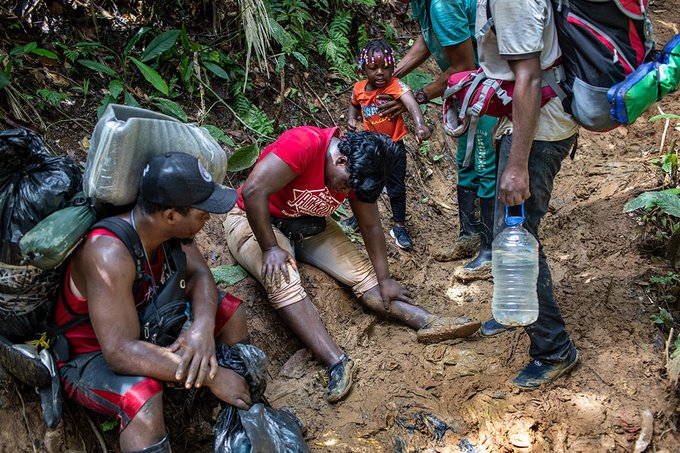
Once in Acandi, migrants will head for the Darien Gap jungle, a dangerous hike that can take ten or more days. Many pay to be led by local guides, or “coyotes.” Along the route are smugglers and criminal groups, including members of the Revolutionary Armed Forces of Colombia and the Gulf Clan, a paramilitary group and Colombia’s largest drug cartel. These groups often extort and sexually assault migrants. “Deep in the jungle, robbery, rape, and human trafficking are as dangerous as wild animals, insects and the absolute lack of safe drinking water,” Jean Gough, then regional director for Latin America and the Caribbean at the UN Children’s Fund (UNICEF), said in an October 2021 news release. “week after week, more children are dying, losing their parents, or getting separated from their relatives while on this perilous journey.” UNICEF estimated that half of the children who crossed in the first six months of 2023 were under five years old.
The environment presents an equally large challenge. The Darien Gap is one of the wettest regions in the world, and frequent rainfall can trigger landslides in mountainous terrain. Temperatures can reach 35 C with high humidity, exacerbating persistent thirst and hunger. The area’s wildlife, including crocodiles and venomous snakes, adds to the dangers migrants face.
Source: Council on Foreign Relations