Photo credit: Toronto Star
Toronto Mayor Olivia Chow is increasing her campaign to get Ottawa to cover the city’s refugee shelter costs, after the federal government slashed support and left a $107 million hole in the city’s budget.
Toronto Today reports that in an August 20 newsletter to councillors, the mayor said the federal government has “arbitrarily” decided to only cover 26% of the city’s projected expenses for housing refugees in Toronto’s overburdened shelter system.
The city houses more refugees in its shelters than any other city in Canada. This is because it’s the primary landing spot for new arrivals. The number of refugees in the shelter system has grown from about 550 per night in 2021 to a peak of nearly 6,500 in August 2024.
Chow said the $107-million budget shortfall is equivalent to a property tax hike of more than two per cent.
In the letter, Chow restated her longstanding request for Ottawa to cover 95 per cent of the city’s refugee shelter costs because “providing safe shelter for refugee claimants is a federal responsibility and the city and province cannot shoulder the cost.”
Chow asked the city’s councillors to put pressure on their federal counterparts and “echo this request” with Toronto-area MPs.
Although the federal government controls immigration policy, municipalities are responsible for shelter and housing costs. It has resulted in an ongoing tug-of-war between Ottawa and local governments since the growing number of refugee claimants needing shelter has put a burden on city budgets.
The Ontario Big City Mayors caucus, a group representing the mayors of the province’s 29 largest cities, recently passed a motion urging the federal government to keep helping municipalities cover these costs.
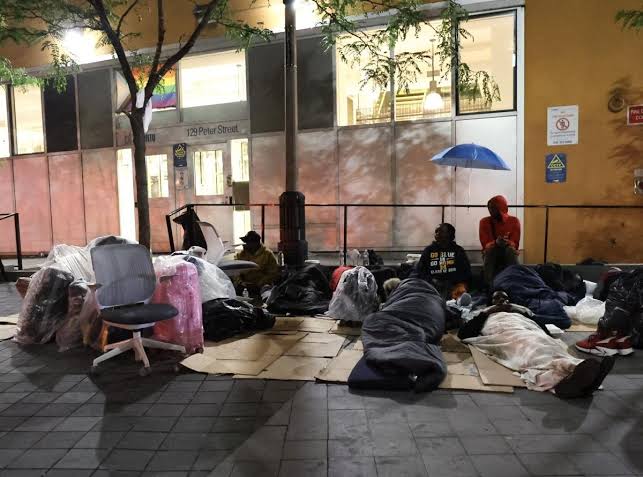
After a dispute between Toronto and Ottawa over who was responsible for housing costs in 2023, refugee claimants were left sleeping rough outside an intake office at the intersection of Richmond and Peter streets.
The federal government soon came through with the money.
The current dispute centres on the city’s application to the Interim Housing Assistance Program, the main federal funding stream for refugee shelter costs which has historically covered 95 per cent of the city’s costs.
Toronto had asked for $671 million in February to cover the costs of housing refugees in the shelter system for a period of just over two years, from January 2025 through March 2027.
Ottawa promised to cover just under $110 million for the first 14 months, or 26 pr cent of the city’s ask, and $152 million for the remaining period, or 62 per cent.
As of August 8, over 3,500 refugees were in Toronto’s shelter system, making up about 40 per cent of the total sheltered population, according to a briefing note from the city’s shelter department. The note warned that the city may be forced to scale back or stop kts shelter expansion if Ottawa does not provide more money.
The funding gap would also delay the transition away from costly hotel programs to purpose-built shelters, and slow the rollout of a new case management system meant to help refugees move through the shelter system more quickly.
Ottawa had, in December 2024, announced plans to gradually reduce its share of refugee shelter costs to cities from 96 per cent to 50 per cent over two years. That announcement has been a source of mounting tensions with cities