Photo credit: TVC
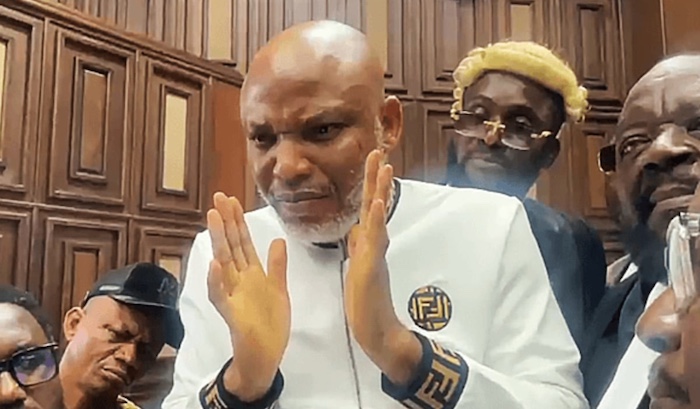
A Nigerian court has on Thursday convicted Nnamdi Kanu of all seven terrorism-related charges brought against him. The court sentenced him to life imprisonment.
Kanu is the founder of the Indigenous People of Biafra (IPOB), which has been accused of terrorism and extra-judicial killings in the country’s southeastern region where it has called for the creation of an independent case.
Although Kanu rejected the court’s authority to try him, he was charged for carrying out acts of terrorism, issuing and violently enforcing stay-at-home orders that bring the southeastern region to a halt every Monday, giving guidance on how to make bombs to be used on government facilities, and incitement.
But will Kanu’s sentence stop the clamour for a Biafran nation?
I really doubt if it will!
Kanu is deeply symbolic for many IPOB supporters and for a segment of the Igbo nationalist movement. His arrest, trial, and detention therefore energize parts of the movement.
Even with his life imprisonment, the grievances he taps into are structural (political exclusion, economic marginalization, perceived injustice), and those don’t simply disappear with his incarceration.
While sentencing Kanu, the judge acknowledged that “the right to self-determination is a political right” but argued that what Kanu was doing was “not done according to the constitution of Nigeria is illegal.”
This argument is a leeway for people who didn’t know they had the right to self-determination. They may find solution as long as they keep to the laws of the land.
Meanwhile, some civil-society groups are already pushing for a political resolution instead of pure criminalization. For instance, the civil society group, Rule of Law and Accountability Advocacy Centre (RULAAC) is calling for a political solution, demilitarization, and greater inclusion. This suggests that a segment of the movement or its sympathizers don’t see prison as the end of agitation, they want a negotiated change.
There are splinter groups, or potential for new leaders to emerge if Kanu is sidelined. The Biafra movement is not monolithic. Some may radicalize further: others might push for a more political or institutional path through referendums and local autonomy.
IPOB’s “sit-at-home” protests have had economic impact, according to court documents. These kinds of tactics don’t require Kanu to be free: they can continue, or evolve, under different leadership.
The government may use this conviction to crack down harder on IPOB and related separatist organizations. If more moderate voices feel sidelined a d the only visible leader is jailed, some activists may go underground.
However, there’s a realistic path for dialogue, especially, if external pressure (civil-society, international actors) mounts. With time, without charismatic leadership, the movement could lose momentum, but this depends heavily on whether root causes are addressed.
Although Kanu’s life sentence is a major blow for IPOB, it is not likely to completely extinguish the Biafra agitation, because the forces behind the movement are deeper than one person. However, his imprisonment could reshape how the movement organizes.
It could either seek negotiation or radicalization!