Photo credit: Wikipedia
Of course!
We should rejoice, I mean, all of us.
After all, Sokoto is almost in another country. In any case, other countries are there to protect us from terrorists.
Even in the highest levels of authority, we are politically and morally neophytes.
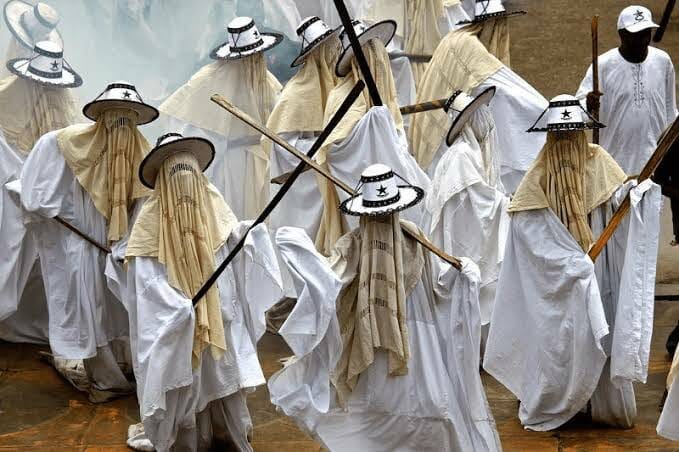
If it were not so, would we even dare to celebrate any festival while a section of the country, our country, is besieged by terrorists?
I acknowledge that a significant amount of money and resources would have been invested in the Eyo festival, but this highlights our lack of moral sensitivity.
Is it not a shame that while the nation is facing a grave security crisis in terms of mass killings, kidnappings, displaced communities, and a widely acknowledged failure of the state to protect lives, we are busy flexing?
For a foreign power to come and offer us security is just a shame and national humiliation.
But then, days later, we are staging a colourful, tourist-facing cultural celebration; is it not a contrast?
Blood is still fresh in many parts of the country, families are mourning, and our so-called sovereignty has been publicly exposed as a fragile one.
Methinks, instead of a celebration, we should have spared a moment for sober reflection.
We ought to have remembered our lost glories. Let me mention one, in the 1970s, Nigeria was an honorary member of the TZAMB, a group of Front-Line states fighting against apartheid because of its full support against apartheid.
However, we seem to be sinking deeper and deeper into a cesspool of insecurity, corruption, and the like.
Yet, we seem to have lost our thinking caps as a people.
I’m a supporter of cultures. So the celebration of whatever festival is not my problem. Culture should not be suspended indefinitely. However, when a state appears more invested in pageantry than national issues, it sends an implicit message.
Lagos is not just a random state. It is a former capital, it serves as the economic nerve centre of the nation and what Lagos does is frequently interpreted as what Nigeria is.
So, celebrating so soon after a foreign military action against “Nigerian” bandits risks projecting a country unbothered by its own loss of control.
The festival could have been postponed briefly, it could have been dedicated to victims of insecurity, and it could have been paired with a strong, solemn statement on sovereignty and security
The authorities could have used the platform to demand national accountability
The.Eyo festival further cements the normalixzation of abnormality in Nigeria.
Although it may be administratively permissible to celebrate the festival, politically and morally, the timing is poor. In moments of national vulnerability, leaders are judged not by what they do, but by what they choose to postpone.
122725