Photo credit: Oregon live
Some fourteen years ago, Cassie Ridgway held her first clothing swap in Portland, Oregon.
AP reports that then, she had a few goals: keep clothing out of landfills, help people find free fashion treasures, and build community.
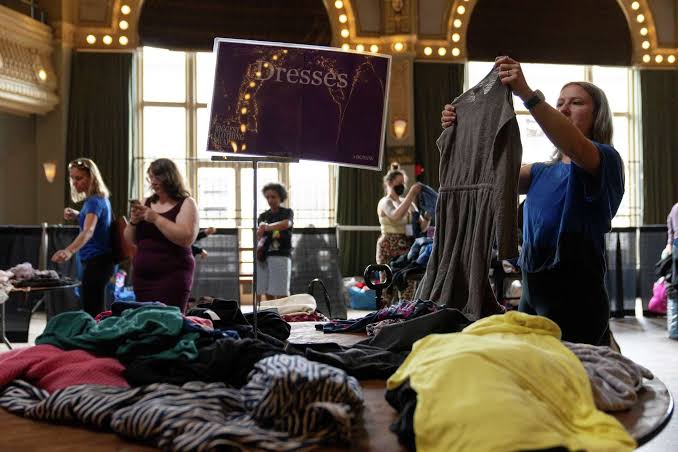
That initial swap attracted about 150 people. Now, the twice-yearly event draws between 500 and 850 participants to share clothes and accessories in a party-like atmosphere.
The organizers call it The Biggest Swap in the Northwest.
Ridgway’s co-founder Elizabeth Mollo said, “We have a DJ and two bars, so there’s some singing and dancing. But no one’s getting drunk at 1 pm on a Saturday.”
The swap is part of a larger movement across the country to share resources with neighbours – one shirt, meal or book at a time.
While there’s an entry fee of $10 to the Portland event to cover costs, the clothes are free, and there’s no limit to how much participants can take. People bring their gently used clothing, shoes and accessories to a sorting station. Volunteers then sort it into bins and on tables.
Ridgway sees the process as an answer to the throwaway “fast fashion.” She says the peak is when sorters are in the process of sorting the products, “we see the true ramifications of consumer culture and waste.”
It’s a case of almost nothing is wasted as leftover clothing is donated to another free neighbourhood swapping event.
Mollo says, “It gets a little chaotic. Where else can you get a whole wardrobe for $10?”
People return year after year.
As prices are going north for many food items, community resource sharing becomes increasingly important, says Taylor Scott in Richmond, Virginia. She offers tomatoes from her garden as she produces more than she can consume. She opened a community fridge outside a cafe in January 2021.
She says, “We’ve built so much food that would have gone to waste.”
The project has grown and become RVA Community Fridges, food donations expanding from restaurants and farms to include private events and weddings. It now has a crew of volunteers that runs 14 fridges. The organization has given away more than 520,000 pounds of food.
The president of the RVA Community Fridges, Scott, says she also likes that the fridge sites have become neighbourhood gathering spots. She’s seen people who once needed the food share become volunteers when they’re in a better place.
Book exchanges are not left out. There is the Little Free Library, the nonprofit behind those cute little book huts that dot communities nationwide. The libraries offer round-the-clock access to free books that inspire meaningful interactions.
Little Free Library CEO Daniel Gummit says, “Access to books directly correlates to literacy in children.”