Photo credit: The Guardian
This article contains content some readers may find distressing.
Noor Hamman is a clinical nutritional volunteer for Action Against Hunger, an international NGO caring for malnourished children and pregnant women who are slowly wasting away in Gaza.
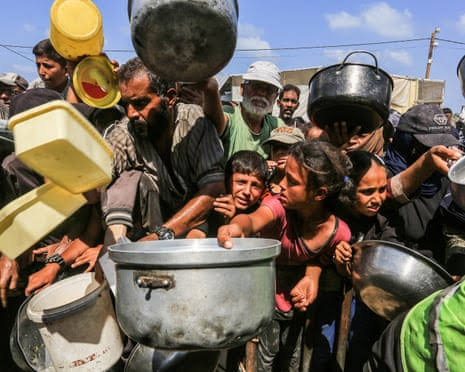
SBS News reports that she describes the brutal effects of starvation on the body: As muscle and fat break down, bones protrude from rust-coloured skin; hair and nails fall out; the stomach bloats as it retains fluid. It is a disturbing juxtaposition against a frail frame.
Hammad says, “Patients suffer from emaciation, pallor, the inability to walk or even talk or play, and suffer from severe anaemia, severe undernutrition, and kwashiorkor.
“We have several cases of malnourished children and women dying. Some pregnant women who suffer from malnutrition have miscarried their foetuses due to a lack of food.
“We lost many patents before our eyes. I was unable to help them at all; I felt helpless.”
She treats hundreds of children suffering from malnutrition every week.
Hammad was pregnant with Hour when the conflict escalated. She gave birth in January 2024. Although she was able to keep her daughter alive, Hour remains malnourished.
Mother and child, along with Hammad’s husband, live in a small tent “not fit for human habitation” in al-Mawasi. The place is an airport-sized strip of desolate, sandy terrain near Khan Younis in Gaza’s south.
Al-Mawasi itself was declared a “humanitarian zone” by the Israel Defence Forces (IDF) in December 2023 and, according to United Nations figures, now shelters more than 47,700 people per square kilometre.
Many Palestinians have been instructed to relocate there under evacuation orders. Despite its designation, it has been the site of several deadly attacks. The flow of humanitarian aid into al-Mawasi has also been hindered.
Hammad says, “We have not received any aid for six months.
“But this month, goods have started entering at very high prices.”
Thousands of trucks loaded with much-needed supplies sit idly beyond Gaza’s southern border with Egypt, just kilometres away from the camp.
Hammad says, “When I know that food aid is on the other side of us … it makes me feel that the world is negligent.
“I do not know how they do this to us while we are innocent.”
Although Gaza was once a thriving agricultural hub, cropland has been widely decimated due to serial bombardment, and the fishing industry has collapsed as a result of attacks on fishers and restrictions imposed by Israel since October 2023, according to the UN’s Food and Agriculture Organisation.
Israel’s excuses for enforcing restrictions along Gaza’s coast are for security reasons, and it also alleges that Hamas attempted to use fishing boats during the October 2023 attacks.
Although food is practically unavailable in Gaza, Israel has heavily restricted the entry of aid into Gaza since late May. Before that, aid was barred entirely from 2 March, when talks to extend a tenuous ceasefire broke down.
However, a spokesperson for the IDF denied that aid has been blocked, saying, “The IDF forcefully rejects the allegation of deliberate starvation of the civilian population.
“The IDF is allowing the entry of humanitarian aid into the Gaza Strip in line with the government’s directives, and allows international organisations to carry out its distribution. Even today, there is still humanitarian aid, which it’s [sic] entry was facilitated by the IDF, that remains uncollected.”
Despite Israel’s claims, the UN-backed Integrated Food Security Phase Classification (IPC) has been warning for weeks that the “worst-case famine scenario” is unfolding on a population of 2.1 million. On Friday, IPC determined that Gaza City and surrounding areas are officially suffering from famine, and predicted that famine conditions would spread to the central and southern areas of Deir al-Balah and Khan Younis by the end of next month