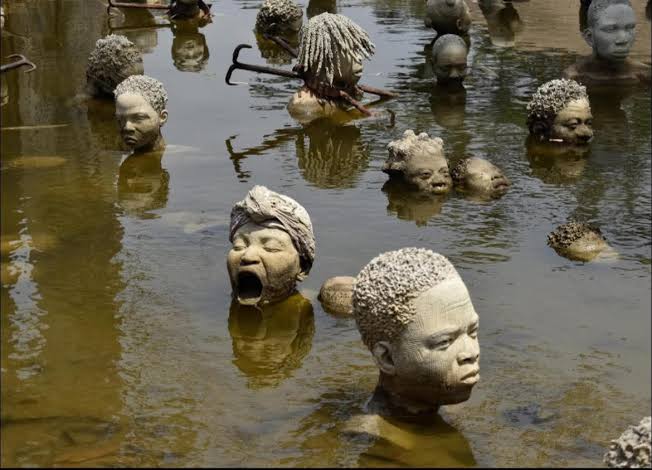
Tucked away at Dunbar Creek on St. Simons Island, Glynn County, Georgia is a historic site called Ibo Landing, Ebo Landing or Ebos Landing).
It was the setting of a mass suicide in 1803 by captive Igbo people who had taken control of the slave ship they were on and refused to submit to slavery in the United States.The event’s moral value as a story of resistance towards slavery has symbolic importance in African American folklore and the flying Africans legend, and in literary history.
In May 1803, a shipload of captive West Africans, were landed by US-paid captors in Savannah by a slave ship, to be auctioned off at one of the local slave markets. The ship’s enslaved passengers included a number of Igbo people from the present-day Nigeria. The igbo were known by planters and slavers of the American South for being fiercely independent and resistant to chattel slavery. The group of 75 enslaved Igbo people were bought by agents of John Cooper and Thomas Spalding for forced labour on their plantations in St Simons Island for $100 each.
The chained enslaved people were packed under the deck of a small vessel named The Schooner York to be shipped to the island – other sources say the voyage took place above The Morovia. During the voyage the Igbo slaves rose up in rebellion, taking control of the ship and drowning their captors, in the process causing the grounding of the vessel in Dunbar Creek at the site now known as Igbo Landing.
There are several versions of the revolt’s development, some of which are considered mythological. Apparently, the West Africans went ashore and subsequently, under the direction of a high Igbo chief among them, walked in unison into the creek singing in the Igbo language. “The Water Spirit brought us, the Water Spirit will take us home”. They thereby accepted the protection of their god Chukwu and death over the alternative of slavery.
Roswell King, a white overseer of the nearby Pierce Butler plantation wrote one of the few contemporary accounts of the incident, which states that as soon as the Igbo landed on St Simons Island they took to the swamp, committing suicide by walking in to Dunbar Creek. A 19th century account of the event identifies the captain by the surname Patterson and names Roswell King as the person who recovered the bodies of the drowned. A letter describing the event written by Savannah slave dealer William Mein states that the Igbo walked into the marsh, where 10 to 12 drowned, while some were “salvaged” by bounty hunters who received $10 a head from Spaldina and Couper.
Igbo Landing was the final scene of events which in 1803 amounted to a “major act of resistance” by Africans. These events have had enduring symbolic importance in African-American folklore and literary history. The act of the Igbo people has been described as the first “freedom march” in the history of America.