Every Child Matters: The Origin of The Orange Shirt Day!
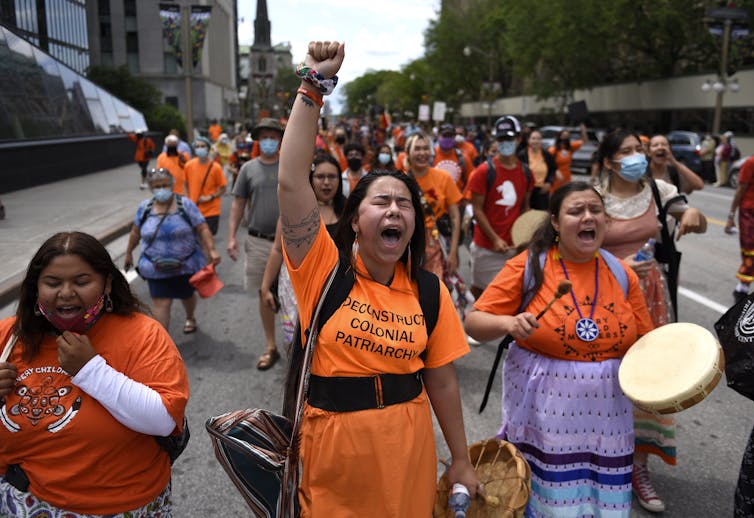
Today is September 30, and many people across Canada(Turtle Island) will wear bright orange t-shirts to honour and raise awareness of the thousands of Indigenous children who were sent to residential schools. Children were forced from homes, endured horrific torture, subjected to deliberate suppression of their cultures and languages, and many never returned to their families. On Orange Shirt Day, Survivors of these institutions and the long-standing effects on generations of First Nations, Metis, and Inuit Peoples are also remembered.
When Phyllis Webstad was a little girl, she was forced to attend a residential school in Williams Lake, British Columbia. On the first day of school, she proudly wore an orange shirt her grandmother had given her. The residential school staff stripped her of her belongings, cut her hair, and took away her clothes, including her orange shirt.
‘When I got to the Mission, they stripped me and took away my clothes, including the orange shirt! I never wore it again. I didn’t understand why they wouldn’t give it back to me. It was mine! The color orange has always reminded and how my feelings didn’t matter, how no one cared and how I felt like I was worth nothing. All of us little children were crying and no one cared.’
– Phyllis Webstad
Colonization is the action or process of settling among and establishing control over the Indigenous people of an area. It is the process where one group of people takes control of another group’s land, resources, and people. Violent force is often used to establish settlements and impose the colonizers’ own political, economic, and cultural systems on the colonized peoples.
Naturally, colonization involves establishing dominance over Indigenous populations and extracting benefits for the colonizing power, leading to loss of culture, displacement, and long-lasting negative consequences to the colonized.
The key aspects of colonization are:
X Establishment of control: A foreign power asserts political and economic power over a new territory and its native inhabitants.
X Settlement: Migrants from the colonizing country establish permanent settlements on the land.
X Imposition of systems: The colonizers impose their own governments, laws, religions, and economic practices on the colonized people/
X Exploitation: Colonization is often driven by the desire to exploit resources, labour, and markets for the benefit of the colonizing nation.
X Cultural dominance: The culture, language, and traditions of the colonizers are imposed, often suppressing or erasing existing Indigenous cultures.
X Displacement and violence: Colonization frequently involves violence, displacement of native populations, and the introduction of diseases that decimate Indigenous communities.
In North America, European settlers colonized Indigenous lands and imposed their systems. They also seized control of resources, and the lives of Indigenous peoples were changed.
In India, British colonial rule led to widespread economic manipulation, forced changes in agricultural practices, and policies that led to significant hardship for the Indian population.
In Africa, the so-called “Scramble for Africa,” as European colonization is commonly known, involved the rapid division of the continent among European powers for economic gain and strategic advantage. Technological advancements, such as steamships, railways, and medicine, facilitated the expansion/ The Berlin Conference formalized the partitioning, leading to the incorporation of nearly all of \Africa.
The disadvantages of colonialism far outweigh its advantages. This is because any system that gives superiority to a group of people is suspect. It also leads to the fact that we should all be equal before God and man.
That is why people who try to suppress others will always resort to violent means.
Who can forget the story of the Trans-Atlantic Slave Trade in Africa?
Man, in that period, was at his lowest in terms of brutality. How can a humane human be withstanding the horror of being so horrible to other men?
How I wish we knew that all lives matter!
It doesn’t matter if you’re white, yellow, black or red!
Every life matters!